
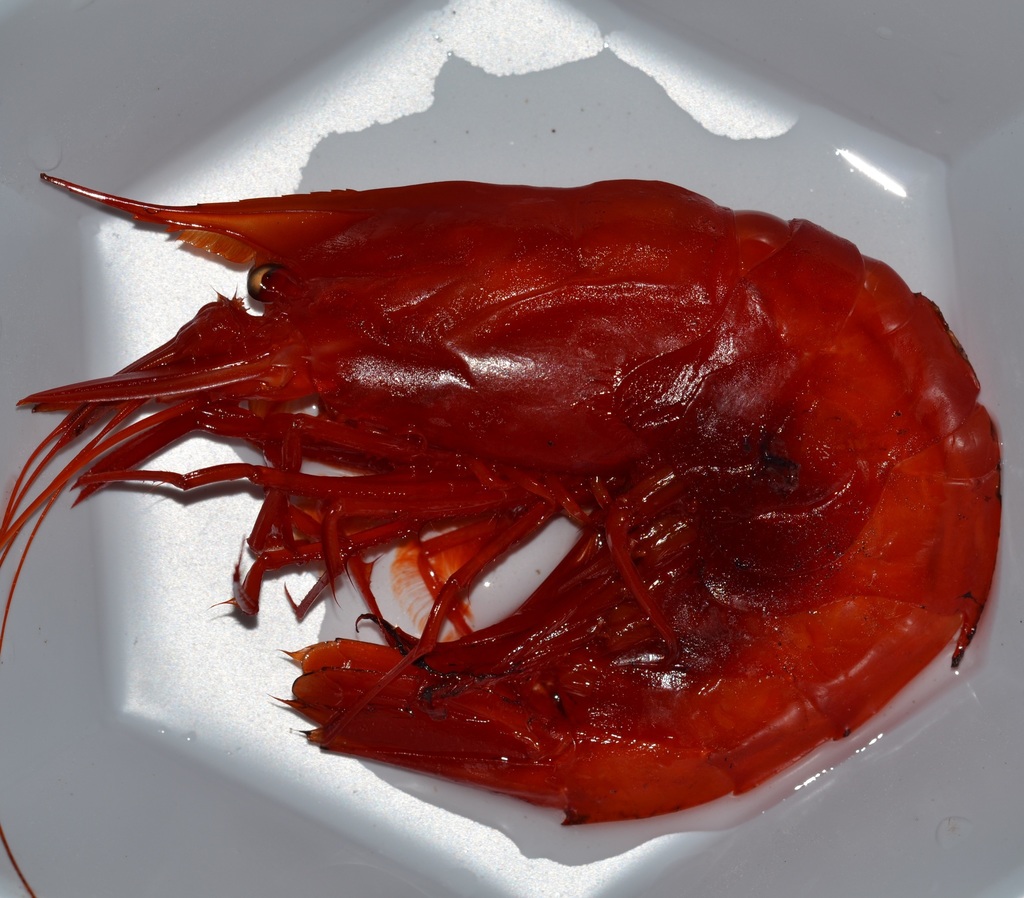
Purple deep-sea shrimp
Acanthephyra purpurea
- Usual depth123–1,745 m
- Water temperature0–28 °C
- Best monthsJune, October, and November
- How commonOccasional
About this species
Acanthephyra purpurea, sometimes called the fire-breathing shrimp, is a species of bioluminescent deep sea shrimp first described in 1881. The species is known for 'vomiting' bioluminescent fluid when distressed, although the fluid likely originates from the hepatopancreas and not the stomach.
Text from the Wikipedia article “Acanthephyra purpurea”, licensed CC BY-SA 4.0. Read the article
Where and when
Where it has been recorded
Worldwide
Loading the map
Best months
Worldwide (open data)
- January: 18 records
- February: 36 records
- March: 62 records
- April: 60 records
- May: 105 records
- June: 197 records
- July: 88 records
- August: 20 records
- September: 46 records
- October: 120 records
- November: 122 records
- December: 8 records
Depth and water temperature
Depth
Mostly recorded at 123–1,745 m · Deepest record: 5,370 m
Water temperature
Recorded in surface water of 0–28 °C
Names and classification
- English
- Purple deep-sea shrimp, Fire-breathing Shrimp, purple deep-sea shrimp
Names in 1 more languages
- French
- crevette pourpre
Other scientific names: Acanthephyra abyssorum, Hoplocaricyphus similis, Miersia agassizii
Similar species
 Dressed deep-sea shrimp
Acanthephyra eximia
- Spiny pelagic deep-sea shrimp
Acanthephyra pelagica
- Sharp-nosed deep-sea shrimp
Acanthephyra acutifrons
Sources and credits
Names and taxonomy: WoRMS (CC BY 4.0) and the GBIF Backbone (CC BY 4.0). Photos: iNaturalist observers, each under the licence shown (CC0, CC BY or CC BY-SA).
- Depth, temperature, months and maps: records from OBIS and GBIF under CC0 or CC BY.
- Descriptions: Wikipedia, licensed CC BY-SA, each linked to its article.
- Conservation status as published by GBIF (IUCN Red List).
- 1,074 open-data records from 1963 to 2024.
Log what you see on your next dive
The free DiveHive diver app keeps your logbook with every sighting and shows what lives at the site you dive next.