
Black Bream
Acanthopagrus butcheri
- Usual depth2–4 m
- Water temperature14–27 °C
- Best monthsJanuary
- How commonOccasional
About this species
The black bream, also commonly known as the southern black bream, southern bream and blue-nosed bream, is a species of anadromous ray-finned fish of the porgy family Sparidae. A deep-bodied fish, it is occasionally confused with other similar species that occur within its range, but is generally distinguished from these species by a lack of yellow ventral and anal fins. Southern black bream are endemic to the southern coasts of Australia from Shark Bay in Western Australia to Ulladulla, New South Wales, as well as Tasmania.
Text from the Wikipedia article “Acanthopagrus butcheri”, licensed CC BY-SA 4.0. Read the article
Where and when
Where it has been recorded
Worldwide
Loading the map
Best months
Worldwide (open data)
- January: 203 records
- February: 99 records
- March: 49 records
- April: 18 records
- May: 6 records
- June: 29 records
- July: 27 records
- August: 24 records
- September: 7 records
- October: 28 records
- November: 80 records
- December: 60 records
Depth and water temperature
Depth
Mostly recorded at 2–4 m · Deepest record: 5 m
Water temperature
Recorded in surface water of 14–27 °C
Names and classification
- English
- Black Bream, Blue Nose Bream, Blue-nosed Bream, Gippsland Bream, Golden Bream, Silver Bream, Southern Black Bream, Southern Bream, Southern Yellowfin Bream, Yellow-fin Bream
Names in 1 more languages
- Simplified Chinese
- 布氏棘鯛
Other scientific names: Mylio butcheri
Similar species
- Australian Seabream
Acanthopagrus australis
- Grey Bream
Acanthopagrus latus
- Blackhead Seabream
Acanthopagrus schlegelii
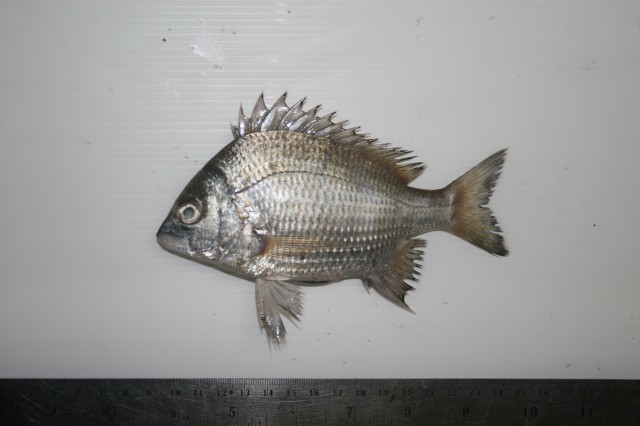 Picnic seabream
Acanthopagrus berda
- Doublebar bream
Acanthopagrus bifasciatus
- Bridled Seabream
Acanthopagrus catenula
Sources and credits
Names and taxonomy: WoRMS (CC BY 4.0) and the GBIF Backbone (CC BY 4.0). Photos: iNaturalist observers, each under the licence shown (CC0, CC BY or CC BY-SA).
- Depth, temperature, months and maps: records from OBIS and GBIF under CC0 or CC BY.
- Descriptions: Wikipedia, licensed CC BY-SA, each linked to its article.
- Conservation status as published by GBIF (IUCN Red List).
- 4,342 open-data records from 1917 to 2018.
Log what you see on your next dive
The free DiveHive diver app keeps your logbook with every sighting and shows what lives at the site you dive next.