
Conmuri
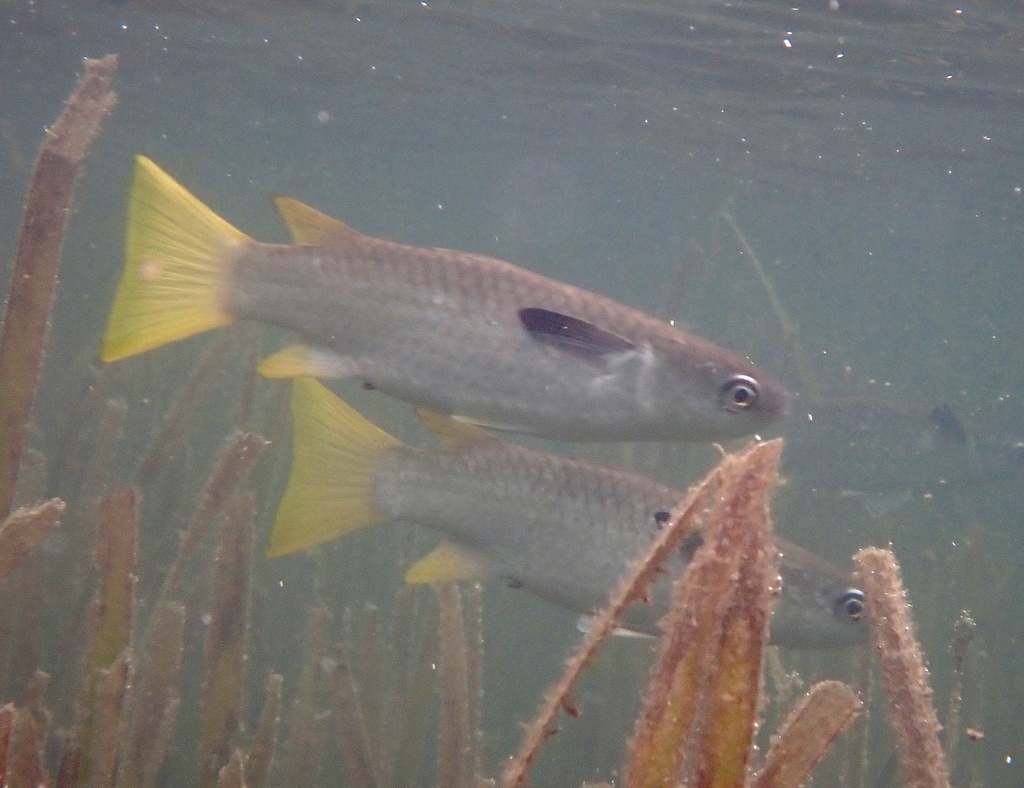
Aldrichetta forsteri
- Usual depth1–5 m
- Water temperature12–22 °C
- Best monthsJanuary, February, and March
- How commonCommon
About this species
Yellow-eye mullet, are small, near-shore fish found in temperate waters of southern Australia from just north of Sydney, New South Wales to Shark Bay in Western Australia, around Tasmania, and New Zealand. Others names are Coorong mullet, conmuri, estuary mullet, Forster's mullet, freshwater mullet, pilch, pilchard, Victor Harbor mullet, yelloweye and yellow-eyed mullet.
Text from the Wikipedia article “Yellow-eye mullet”, licensed CC BY-SA 4.0. Read the article
Where and when
Where it has been recorded
Worldwide
Loading the map
Best months
Worldwide (open data)
- January: 1,887 records
- February: 1,885 records
- March: 1,449 records
- April: 462 records
- May: 174 records
- June: 163 records
- July: 79 records
- August: 140 records
- September: 321 records
- October: 325 records
- November: 784 records
- December: 1,029 records
Depth and water temperature
Depth
Mostly recorded at 1–5 m · Deepest record: 46.5 m
Water temperature
Recorded in surface water of 12–22 °C
Names and classification
- English
- Conmuri, Coorang Mullet, Estuary Mullet, Forster's Mullet, Freshwater Mullet, Pilch, Pilchard, Victor Harbour Mullet, Yelloweye, Yellow-eyed Mullet, Yelloweyed Mullet, yellow-eye mullet, Yelloweye Mullet
Names in 1 more languages
- Spanish
- Mújol de Foster
Other scientific names: Agonostoma diemensis, Agonostomus forsteri, Dajaus diemensis, Mugil albula, Mugil forsteri
Similar species
- Flathead grey mullet
Mugil cephalus
 Diamond-scaled Mullet
Ellochelon vaigiensis
- blue-spot mullet
Crenimugil seheli
- Longarm mullet
Osteomugil cunnesius
- Bigscale Mullet
Planiliza macrolepis
- Brown-backed Mullet
Planiliza subviridis
Sources and credits
Names and taxonomy: WoRMS (CC BY 4.0) and the GBIF Backbone (CC BY 4.0). Photos: iNaturalist observers, each under the licence shown (CC0, CC BY or CC BY-SA).
- Depth, temperature, months and maps: records from OBIS and GBIF under CC0 or CC BY.
- Descriptions: Wikipedia, licensed CC BY-SA, each linked to its article.
- Conservation status as published by GBIF (IUCN Red List).
- 11,803 open-data records from 1899 to 2018.
Log what you see on your next dive
The free DiveHive diver app keeps your logbook with every sighting and shows what lives at the site you dive next.