
Japanese eel
Anguilla japonica
- Usual depth62–150 m
- Water temperature18–29 °C
- Best monthsJuly
- How commonOccasional
About this species
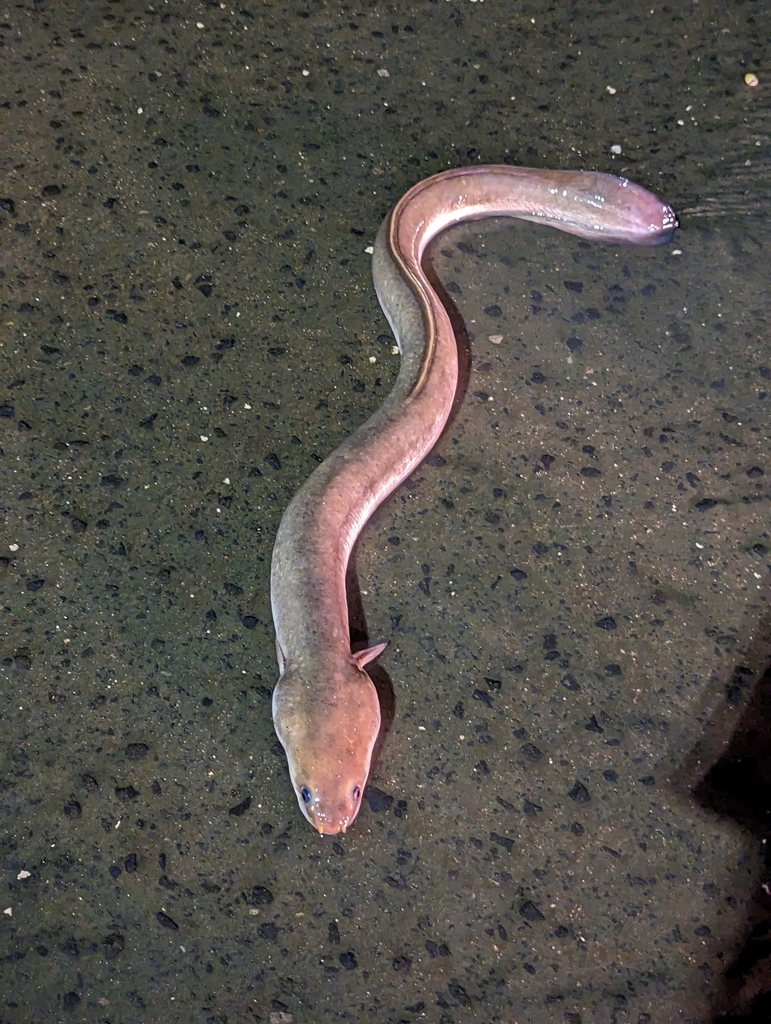
The Japanese eel is a species of anguillid eel found in Japan, Korea, Taiwan, China, and Vietnam, as well as the northern Philippines. Like all the eels of the genus Anguilla and the family Anguillidae, it is catadromous, meaning it spawns in the sea but lives most of its adult life in freshwater.
Text from the Wikipedia article “Japanese eel”, licensed CC BY-SA 4.0. Read the article
Where and when
Where it has been recorded
Worldwide
Loading the map
Best months
Worldwide (open data)
- January: 4 records
- February: 0 records
- March: 6 records
- April: 3 records
- May: 1 records
- June: 68 records
- July: 950 records
- August: 5 records
- September: 15 records
- October: 6 records
- November: 10 records
- December: 20 records
Depth and water temperature
Depth
Mostly recorded at 62–150 m · Deepest record: 437 m
Water temperature
Recorded in surface water of 18–29 °C
Names and classification
- English
- Japanese eel
Names in 8 more languages
- German
- Japanischer Aal
- Spanish
- anguila japonesa, Anguila Nipona
- Filipino
- Igat
- French
- anguille du Japon
- Japanese
- Nihon-unagi, Unagi, ウナギ, ニホンウナギ
- Korean
- 뱀장어
- Thai
- Pla Lai Yeepun
- Simplified Chinese
- Man Yu, 土鰻, 日本鰻, 日本鰻鱺, 日本鳗鲡, 正鰻, 淡水鰻, 白鰻, 白鱔, 鰻鱺
Other scientific names: Anguilla angustidens, Anguilla breviceps, Anguilla manabei, Anguilla nigricans, Anguilla remifera, Anguilla sinensis, Muraena pekinensis
Similar species
- Australian shortfinned eel
Anguilla australis
- Australian Longfin Eel
Anguilla reinhardtii
 Black fin eel
Anguilla bicolor
 Giant mottled eel
Anguilla marmorata
- New Zealand longfin eel
Anguilla dieffenbachii
- African longfin eel
Anguilla mossambica
Sources and credits
Names and taxonomy: WoRMS (CC BY 4.0) and the GBIF Backbone (CC BY 4.0). Photos: iNaturalist observers, each under the licence shown (CC0, CC BY or CC BY-SA).
- Depth, temperature, months and maps: records from OBIS and GBIF under CC0 or CC BY.
- Descriptions: Wikipedia, licensed CC BY-SA, each linked to its article.
- Conservation status as published by GBIF (IUCN Red List).
- 1,142 open-data records from 1846 to 2024.
Log what you see on your next dive
The free DiveHive diver app keeps your logbook with every sighting and shows what lives at the site you dive next.