
Northern Flamboyant Cuttlefish
Ascarosepion tullbergi
- Usual depth82.3 m
- Water temperature21–27 °C
- Best monthsMarch, April, and October
- How commonRare
About this species
Ascarosepion tullbergi, the paintpot cuttlefish, is a small, poorly researched species of cuttlefish found in the Indo-Pacific, between Japan and Hong Kong. It was one of the two species classified in the genus Metasepia, which was lumped into Ascarosepion in 2023. Metasepia cuttlefish are characterized by their small, thick, diamond-shaped cuttlebone, and distinctive body coloration.
Text from the Wikipedia article “Ascarosepion tullbergi”, licensed CC BY-SA 4.0. Read the article
Where and when
Where it has been recorded
Worldwide
Loading the map
Best months
Worldwide (open data)
- January: 0 records
- February: 0 records
- March: 1 records
- April: 1 records
- May: 0 records
- June: 0 records
- July: 0 records
- August: 0 records
- September: 0 records
- October: 1 records
- November: 0 records
- December: 0 records
Depth and water temperature
Depth
Mostly recorded at 82.3 m · Deepest record: 82.3 m
Water temperature
Recorded in surface water of 21–27 °C
Names and classification
- English
- Northern Flamboyant Cuttlefish, Paintpot Cuttlefish
Names in 6 more languages
- Spanish
- Sepia tintero
- French
- Seiche encrier
- Japanese
- ハナイカ
- Korean
- 꽃갑오징어
- Thai
- ปลาหมึกดอกไม้
- Simplified Chinese
- 圖氏後烏賊, 花烏賊, 花烏賊(圖氏後烏賊)
Other scientific names: Metasepia tullbergi, Sepia tullbergi
Similar species
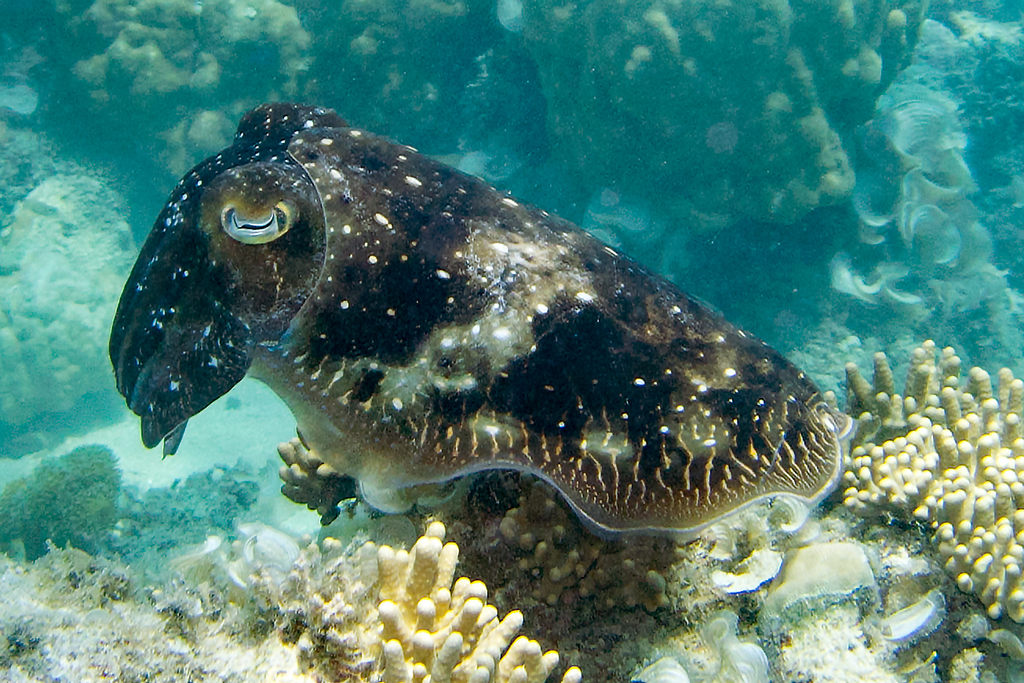 Broadclub Cuttlefish
Ascarosepion latimanus
 Flamboyant Cuttlefish
Ascarosepion pfefferi
- Australian Giant Cuttlefish
Ascarosepion apama
- Reaper Cuttlefish
Ascarosepion mestus
- New Holland Cuttlefish
Ascarosepion novaehollandiae
- Papuan Cuttlefish
Ascarosepion papuense
Sources and credits
Names and taxonomy: WoRMS (CC BY 4.0) and the GBIF Backbone (CC BY 4.0). Photos: iNaturalist observers, each under the licence shown (CC0, CC BY or CC BY-SA).
- Depth, temperature, months and maps: records from OBIS and GBIF under CC0 or CC BY.
- Descriptions: Wikipedia, licensed CC BY-SA, each linked to its article.
- Conservation status as published by GBIF (IUCN Red List).
- 33 open-data records from 1967 to 1972.
Log what you see on your next dive
The free DiveHive diver app keeps your logbook with every sighting and shows what lives at the site you dive next.