
Blackedge Conger
Bathycongrus retrotinctus
- Usual depth183–545 m
- Water temperature22–29 °C
- Best monthsMarch, July, and August
- How commonRare
About this species
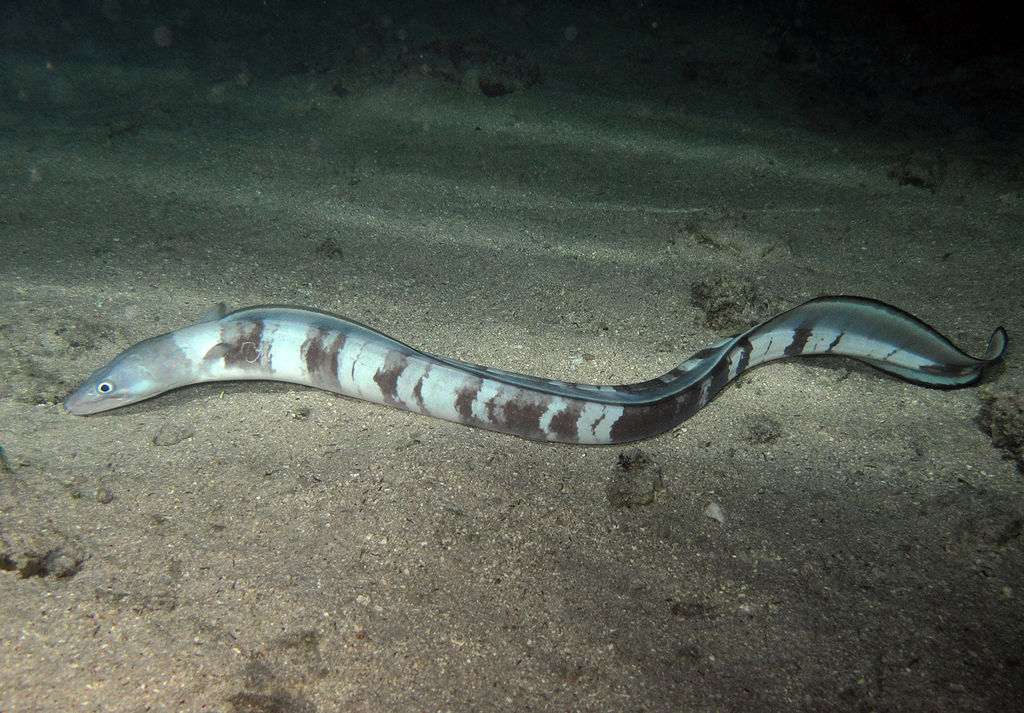
The Blackedge conger is an eel in the family Congridae. It was described by David Starr Jordan and John Otterbein Snyder in 1901, originally under the genus Leptocephalus. It is a marine, deep water-dwelling eel which is known from Japan to the Philippines, in the western Pacific Ocean. It dwells at a depth range of 150–450 metres (490–1,480 ft). Males can reach a maximum total length of 54 centimetres.
Text from the Wikipedia article “Blackedge conger”, licensed CC BY-SA 4.0. Read the article
Where and when
Where it has been recorded
Worldwide
Loading the map
Best months
Worldwide (open data)
- January: 0 records
- February: 0 records
- March: 4 records
- April: 1 records
- May: 1 records
- June: 2 records
- July: 3 records
- August: 5 records
- September: 1 records
- October: 0 records
- November: 1 records
- December: 2 records
Depth and water temperature
Depth
Mostly recorded at 183–545 m · Deepest record: 1,110 m
Water temperature
Recorded in surface water of 22–29 °C
Names and classification
- English
- Blackedge Conger
Names in 3 more languages
- Japanese
- Tsumaguro-anago, Tsumaguroanago, ツマグロアナゴ
- Korean
- 테붕장어
- Simplified Chinese
- 沙鰻, 海鰻, 穴子鰻, 糯米鰻, 網格深海康吉鰻, 網格深海糯鰻, 臭腥鰻, 黑邊深海糯鰻
Other scientific names: Bathycongrus randalli, Leptocephalus retrotinctus, Rhechias retrotincta
Similar species
- Lined Conger
Bathycongrus guttulatus
- Longnose conger
Bathycongrus wallacei
 Longfin African conger
Conger cinereus
- Black spotted garden eel
Heteroconger hassi
- Darkfin Conger
Ariosoma anago
Sources and credits
Names and taxonomy: WoRMS (CC BY 4.0) and the GBIF Backbone (CC BY 4.0). Photos: iNaturalist observers, each under the licence shown (CC0, CC BY or CC BY-SA).
- Depth, temperature, months and maps: records from OBIS and GBIF under CC0 or CC BY.
- Descriptions: Wikipedia, licensed CC BY-SA, each linked to its article.
- Conservation status as published by GBIF (IUCN Red List).
- 48 open-data records from 1906 to 2015.
- Species data updated October 26, 2026.
Log what you see on your next dive
The free DiveHive diver app keeps your logbook with every sighting and shows what lives at the site you dive next.