
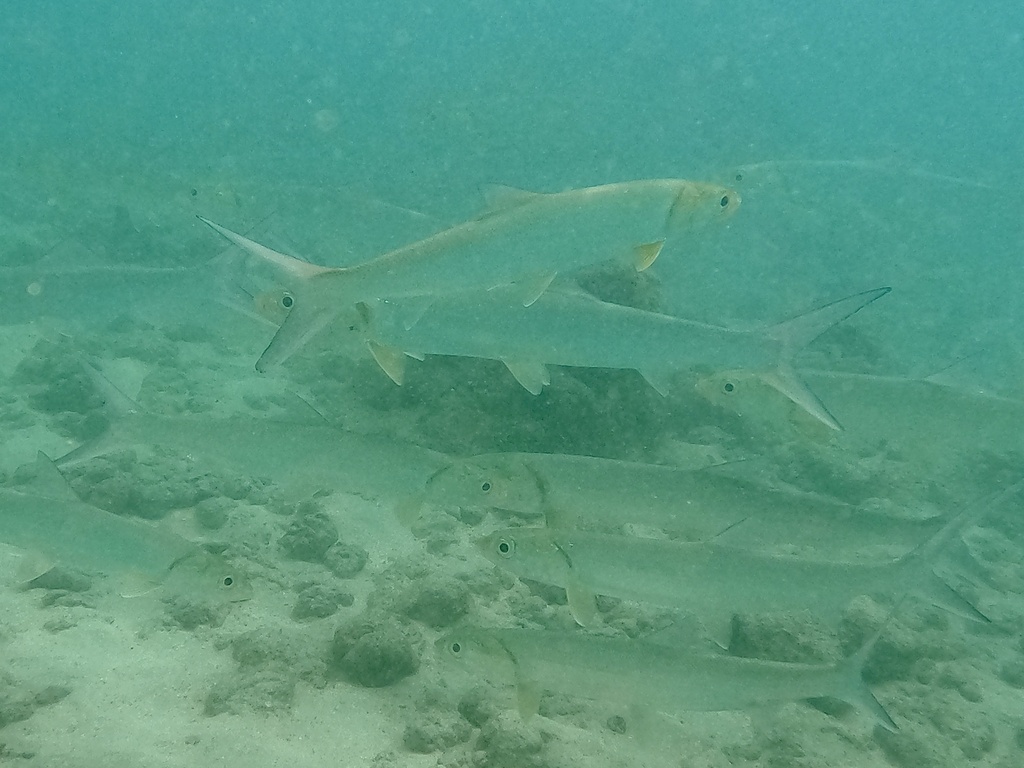
Banana Fsh
Elops hawaiensis
- Usual depth0–114 m
- Water temperature16–29 °C
- Best monthsMay, June, and October
- How commonRare
Photo credit: (c) Chris Sulots, some rights reserved (CC BY) · CC BY · iNaturalist
About this species
The Hawaiian ladyfish, also known as the Hawaiian tenpounder or banana fish, is a species of ray-finned fish in the family Elopidae. It is sometimes referred to as the giant herring, though it is not closely related to the true herrings of the family Clupeidae. Its Hawaiian name is awa 'aua. It is native to the west central Pacific Ocean, and the current classification may in fact consist of several species.
Text from the Wikipedia article “Elops hawaiensis”, licensed CC BY-SA 4.0. Read the article
Where and when
Where it has been recorded
Worldwide
Loading the map
Best months
Worldwide (open data)
- January: 9 records
- February: 6 records
- March: 13 records
- April: 13 records
- May: 23 records
- June: 22 records
- July: 14 records
- August: 9 records
- September: 15 records
- October: 22 records
- November: 3 records
- December: 8 records
Depth and water temperature
Depth
Mostly recorded at 0–114 m · Deepest record: 114 m
Water temperature
Recorded in surface water of 16–29 °C
Photos

(c) 116916927065934112165, some rights reserved (CC BY) · CC BY · iNaturalist 
(c) Hunter Hickok, some rights reserved (CC BY) · CC BY · iNaturalist
Names and classification
- English
- Banana Fsh, Chiro, giant herring, great herring, Hawaiian Giant Herring, Hawaiian ladyfish, Hawaiian Tarpon, Hawaiian Tenpounder, Ladyfish, Pincushionfish, tenpounder, Torres Strait Herring
Names in 6 more languages
- Spanish
- Malacho salmón
- Filipino
- Bid-bid, Bidbid, Bidbir, Mid-bid
- French
- Guinée saumon
- Japanese
- Kara-iwashi, Karaiwashi, カライワシ
- Korean
- 당멸치
- Simplified Chinese
- 夏威夷海鰱, 夏威夷海鲢
Other scientific names: Elops australis, Elops hawaiiensis
Sources and credits
Names and taxonomy: WoRMS (CC BY 4.0) and the GBIF Backbone (CC BY 4.0). Photos: iNaturalist observers, each under the licence shown (CC0, CC BY or CC BY-SA).
- Depth, temperature, months and maps: records from OBIS and GBIF under CC0 or CC BY.
- Descriptions: Wikipedia, licensed CC BY-SA, each linked to its article.
- Conservation status as published by GBIF (IUCN Red List).
- 285 open-data records from 1915 to 2023.
- Species data updated October 26, 2026.
Log what you see on your next dive
The free DiveHive diver app keeps your logbook with every sighting and shows what lives at the site you dive next.