
Barbel flyingfish
Exocoetus monocirrhus
- Usual depth0–3,475 m
- Water temperature19–29 °C
- Best monthsMarch, July, and November
- How commonOccasional
About this species
Exocoetus monocirrhus is a species of fish in the family Exocoetidae.
Text from the Wikipedia article “Exocoetus monocirrhus”, licensed CC BY-SA 4.0. Read the article
Where and when
Where it has been recorded
Worldwide
Loading the map
Best months
Worldwide (open data)
- January: 4 records
- February: 10 records
- March: 18 records
- April: 7 records
- May: 4 records
- June: 2 records
- July: 15 records
- August: 5 records
- September: 4 records
- October: 3 records
- November: 16 records
- December: 7 records
Depth and water temperature
Depth
Mostly recorded at 0–3,475 m · Deepest record: 4,297.7 m
Water temperature
Recorded in surface water of 19–29 °C
Names and classification
- English
- Barbel flyingfish, barbel flyingfish, Barbel Flyingfish
Names in 4 more languages
- Spanish
- volador barbudo
- French
- Exocet barbu, Exocet barbu, Exocet boue, Exocet boue
- Japanese
- Hagoromotobiuo, ハゴロモトビウオ
- Simplified Chinese
- 單鬚飛魚, 飛烏
Other scientific names: Exocaetus monocirrhus, Exocoetus georgianus, Exocoetus melanopus, Exocoetus monocirrous, Halacypselurus borodini, Halocypselus borodini, Halocypselus borodoni
Similar species
- Flying fish
Exocoetus volitans
- Mirrorwing flyingfish
Hirundichthys speculiger
- Sailfin flyingfish
Parexocoetus brachypterus
- African Flyingfish
Parexocoetus mento
 Abe's Flyingfish
Cheilopogon abei
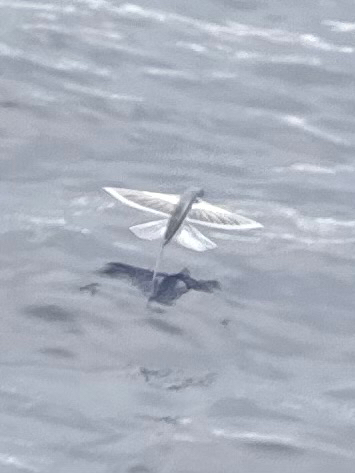 Spotfin flyingfish
Cheilopogon furcatus
Sources and credits
Names and taxonomy: WoRMS (CC BY 4.0) and the GBIF Backbone (CC BY 4.0). Photos: iNaturalist observers, each under the licence shown (CC0, CC BY or CC BY-SA).
- Depth, temperature, months and maps: records from OBIS and GBIF under CC0 or CC BY.
- Descriptions: Wikipedia, licensed CC BY-SA, each linked to its article.
- Conservation status as published by GBIF (IUCN Red List).
- 662 open-data records from 1846 to 2024.
Log what you see on your next dive
The free DiveHive diver app keeps your logbook with every sighting and shows what lives at the site you dive next.