
Flat-faced Seahorse
Hippocampus trimaculatus
- Usual depth2–84 m
- Water temperature14–29 °C
- Best monthsFebruary, June, and July
- How commonRare
About this species
The flat-faced seahorse, longnose seahorse, low-crowned seahorse or three-spot seahorse is a species of fish in the family Syngnathidae. It is found in Australia, Cocos (Keeling) Islands, French Polynesia, China, India, Indonesia, Japan, the Philippines, Singapore, Taiwan, Thailand, and Vietnam. Its natural habitat is shallow seas. It is threatened by habitat loss.
Text from the Wikipedia article “Flat-faced seahorse”, licensed CC BY-SA 4.0. Read the article
Where and when
Where it has been recorded
Worldwide
Loading the map
Best months
Worldwide (open data)
- January: 1 records
- February: 7 records
- March: 2 records
- April: 2 records
- May: 3 records
- June: 5 records
- July: 5 records
- August: 1 records
- September: 3 records
- October: 4 records
- November: 4 records
- December: 2 records
Depth and water temperature
Depth
Mostly recorded at 2–84 m · Deepest record: 98.7 m
Water temperature
Recorded in surface water of 14–29 °C
Names and classification
- English
- Flat-faced Seahorse, Longnose seahorse, Low-crowned Seahorse, Low-crown Seahorse, Lowcrown Seahorse, Smooth Seahorse, Three-spot Seahorse
Names in 5 more languages
- Spanish
- Caballito de Mar de tres Puntos
- Japanese
- Takakura-tatsu, Takakuratatsu, タカクラタツ
- Korean
- 점해마
- Thai
- ม้าน้ำสามจุด
- Simplified Chinese
- 三斑海馬, 海馬
Other scientific names: Hippocampus kampylotrachelos, Hippocampus lenis, Hippocampus manadensis, Hippocampus mannulus, Hippocampus sexmaculatus, Hippocampus takakurae
Similar species
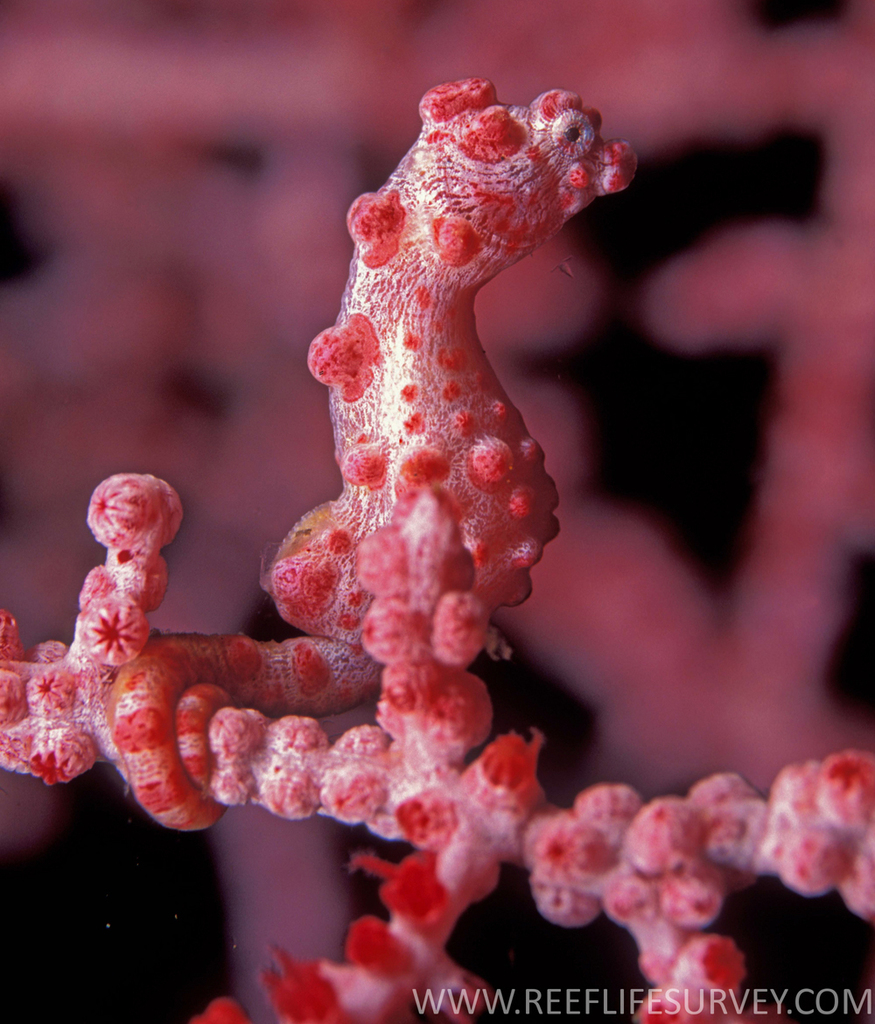 Bargibant's Pygmy Seahorse
Hippocampus bargibanti
- Thorny seahorse
Hippocampus histrix
- Spotted seahorse
Hippocampus kuda
- Big-head Seahorse
Hippocampus angustus
- Barbour's Seahorse
Hippocampus barbouri
- Great Seahorse
Hippocampus kelloggi
Sources and credits
Names and taxonomy: WoRMS (CC BY 4.0) and the GBIF Backbone (CC BY 4.0). Photos: iNaturalist observers, each under the licence shown (CC0, CC BY or CC BY-SA).
- Depth, temperature, months and maps: records from OBIS and GBIF under CC0 or CC BY.
- Descriptions: Wikipedia, licensed CC BY-SA, each linked to its article.
- Conservation status as published by GBIF (IUCN Red List).
- 425 open-data records from 1814 to 2012.
Log what you see on your next dive
The free DiveHive diver app keeps your logbook with every sighting and shows what lives at the site you dive next.