
sap-sap
Leiognathus brevirostris
- Usual depth3–18 m
- Water temperature28–30 °C
- Best monthsMay, September, and November
- How commonRare
About this species
Photopectoralis bindus, commonly known as the shortnose ponyfish or orangefin ponyfish, is a ray-finned fish of brackish and marine waters found from Indo-West Pacific to the Indian coasts and off Sri Lanka to China and south of Australia. Like its relatives, the fish is an amphidromous, demersal species which feeds on diatoms, copepods, Lucifer, nematodes and polychaetes. The fish has eight dorsal spines, sixteen dorsal soft rays, three anal spines and fourteen anal soft rays. Fresh specimens possess a golden gleam which fades with dryness.
Text from the Wikipedia article “Photopectoralis bindus”, licensed CC BY-SA 4.0. Read the article
Where and when
Where it has been recorded
Worldwide
Loading the map
Best months
Worldwide (open data)
- January: 0 records
- February: 0 records
- March: 0 records
- April: 0 records
- May: 2 records
- June: 0 records
- July: 1 records
- August: 0 records
- September: 2 records
- October: 1 records
- November: 2 records
- December: 1 records
Depth and water temperature
Depth
Mostly recorded at 3–18 m · Deepest record: 18 m
Water temperature
Recorded in surface water of 28–30 °C
Names and classification
- English
- sap-sap
Other scientific names: Equula brevirostris
Similar species
- Common ponyfish
Leiognathus equula
- Long-spined Pony-fish
Equulites leuciscus
- Orangefin ponyfish
Photopectoralis bindus
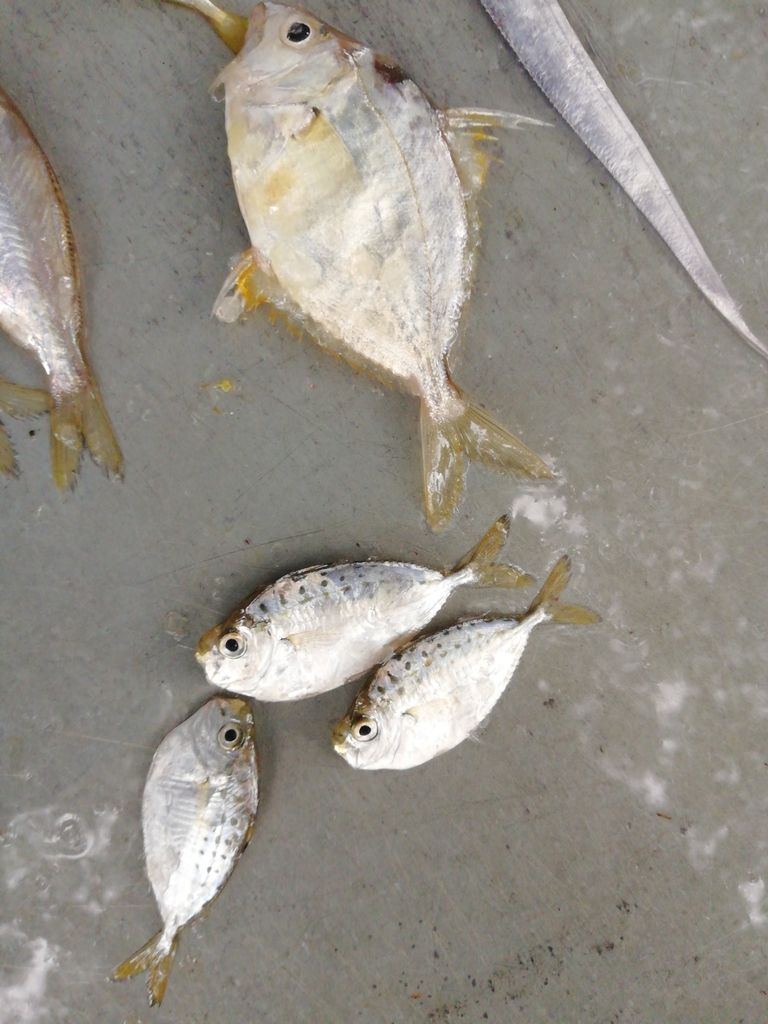 pugnose ponyfish
Deveximentum insidiator
- Elongate Ponyfish
Equulites elongatus
Sources and credits
Names and taxonomy: WoRMS (CC BY 4.0) and the GBIF Backbone (CC BY 4.0). Photos: iNaturalist observers, each under the licence shown (CC0, CC BY or CC BY-SA).
- Depth, temperature, months and maps: records from OBIS and GBIF under CC0 or CC BY.
- Descriptions: Wikipedia, licensed CC BY-SA, each linked to its article.
- Conservation status as published by GBIF (IUCN Red List).
- 51 open-data records from 1957 to 2012.
- Species data updated October 27, 2026.
Log what you see on your next dive
The free DiveHive diver app keeps your logbook with every sighting and shows what lives at the site you dive next.