
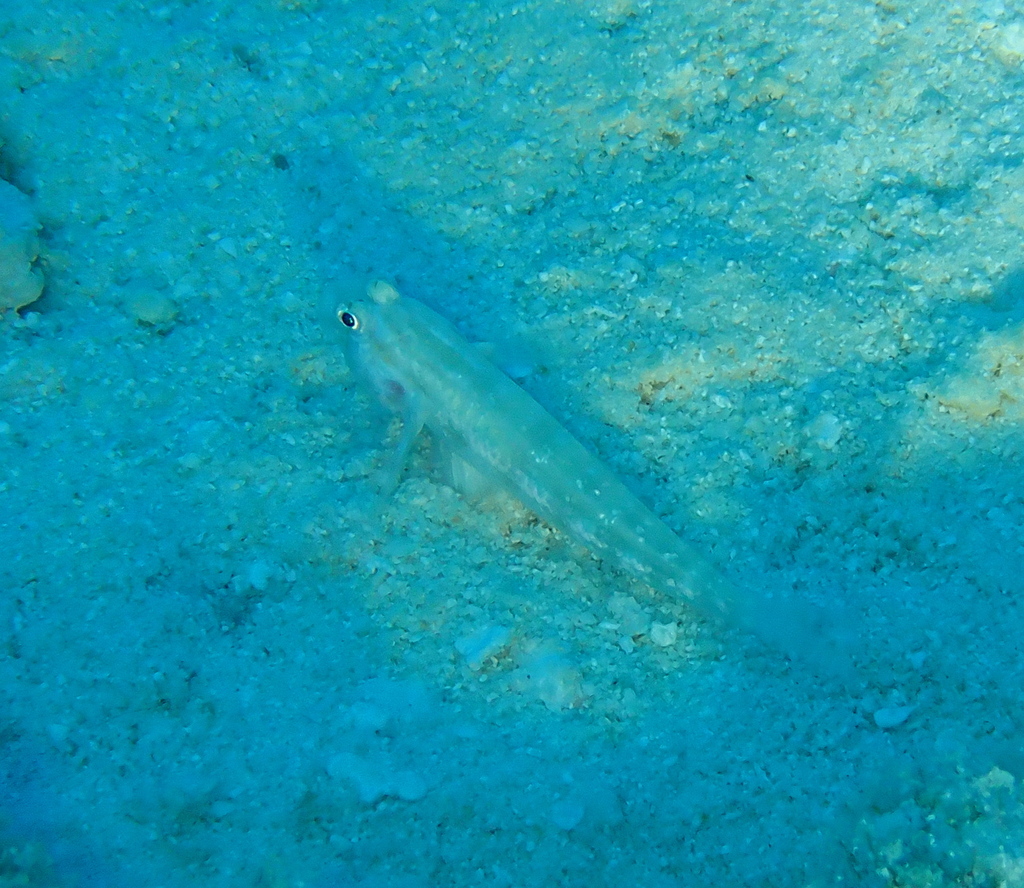
Sharptail goby
Oligolepis acutipennis
- Usual depth1–1 m
- Water temperature21–30 °C
- Best monthsFebruary, July, and August
- How commonRare
About this species
Oligolepis acutipennis, the sharptail goby, is a species of goby native to marine, freshwater and brackish waters along the coasts of Indo-West Pacific region. This species can reach a length of 12 centimetres (4.7 in) TL.
Text from the Wikipedia article “Oligolepis acutipennis”, licensed CC BY-SA 4.0. Read the article
Where and when
Where it has been recorded
Worldwide
Loading the map
Best months
Worldwide (open data)
- January: 5 records
- February: 13 records
- March: 7 records
- April: 4 records
- May: 4 records
- June: 3 records
- July: 11 records
- August: 14 records
- September: 11 records
- October: 6 records
- November: 4 records
- December: 8 records
Depth and water temperature
Depth
Mostly recorded at 1–1 m · Deepest record: 150 m
Water temperature
Recorded in surface water of 21–30 °C
Names and classification
- English
- Sharptail goby, barecheek goby, Longtail Goby, Paintedfin Goby, pointed fin goby, sharptail goby, Spotted Teardrop Goby
Names in 3 more languages
- Japanese
- Noborihaze, ノボリハゼ
- Thai
- ปลาบู่หางยาว
- Simplified Chinese
- 尖鰭寡鱗鰕虎, 尖鰭寡鱗鰕虎魚
Other scientific names: Ctenogobius acutipennis, Ctenogobius acutipinnis, Gobius acutipennis, Gobius melanostigma, Gobius setosus, Oligolepis acutipinnis, Oligolepis acutippinis
Similar species
 Eyebar goby
Gnatholepis cauerensis
- Yellowfin goby
Acanthogobius flavimanus
- Light-beige Goby
Acanthogobius lactipes
- Anjer Eye-bar Goby
Gnatholepis anjerensis
- Barred mudskipper
Periophthalmus argentilineatus
- Atlantic Mudskipper
Periophthalmus barbarus
Sources and credits
Names and taxonomy: WoRMS (CC BY 4.0) and the GBIF Backbone (CC BY 4.0). Photos: iNaturalist observers, each under the licence shown (CC0, CC BY or CC BY-SA).
- Depth, temperature, months and maps: records from OBIS and GBIF under CC0 or CC BY.
- Descriptions: Wikipedia, licensed CC BY-SA, each linked to its article.
- Conservation status as published by GBIF (IUCN Red List).
- 330 open-data records from 1837 to 2015.
Log what you see on your next dive
The free DiveHive diver app keeps your logbook with every sighting and shows what lives at the site you dive next.