
Blue-eye Cardinalfish
Ostorhinchus compressus
- Usual depth3–15 m
- Water temperature24–30 °C
- Best monthsAugust, October, and November
- How commonOccasional
About this species
Ostorhinchus compressus, commonly called the ochre-striped cardinalfish, blue-eyed cardinalfish or split banded cardinalfish, is a marine cardinalfish from the Indo-West Pacific from the family Apogonidae. It occasionally makes its way into the aquarium trade. It grows to a size of 12 cm in length.
Text from the Wikipedia article “Ostorhinchus compressus”, licensed CC BY-SA 4.0. Read the article
Where and when
Where it has been recorded
Worldwide
Loading the map
Best months
Worldwide (open data)
- January: 4 records
- February: 13 records
- March: 10 records
- April: 8 records
- May: 14 records
- June: 4 records
- July: 18 records
- August: 19 records
- September: 14 records
- October: 26 records
- November: 25 records
- December: 1 records
Depth and water temperature
Depth
Mostly recorded at 3–15 m · Deepest record: 30 m
Water temperature
Recorded in surface water of 24–30 °C
Names and classification
- English
- Blue-eye Cardinalfish, Blue-eyed Cardinalfish, Splitband Cardinalfish, Split-banded Cardinalfish
Names in 3 more languages
- French
- Apogon à bandes ocre
- Japanese
- Hiratenjikudai, ヒラテンジクダイ
- Simplified Chinese
- 大目側仔, 大面側仔, 裂帶天竺鯛, 裂帶鸚天竺鯛
Other scientific names: Amia compressa, Apogon compressus, Apogonichthys macrophthalmus
Similar species
- Barred Striped Cardinalfish
Ostorhinchus fasciatus
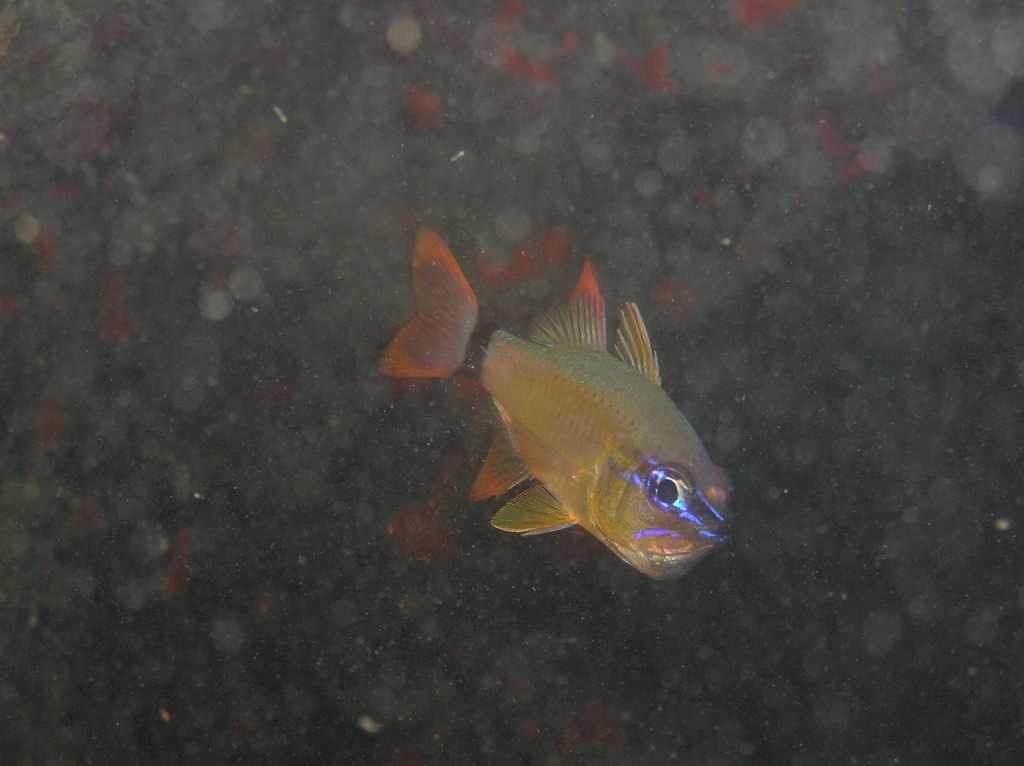 Bandtail Cardinal
Ostorhinchus aureus
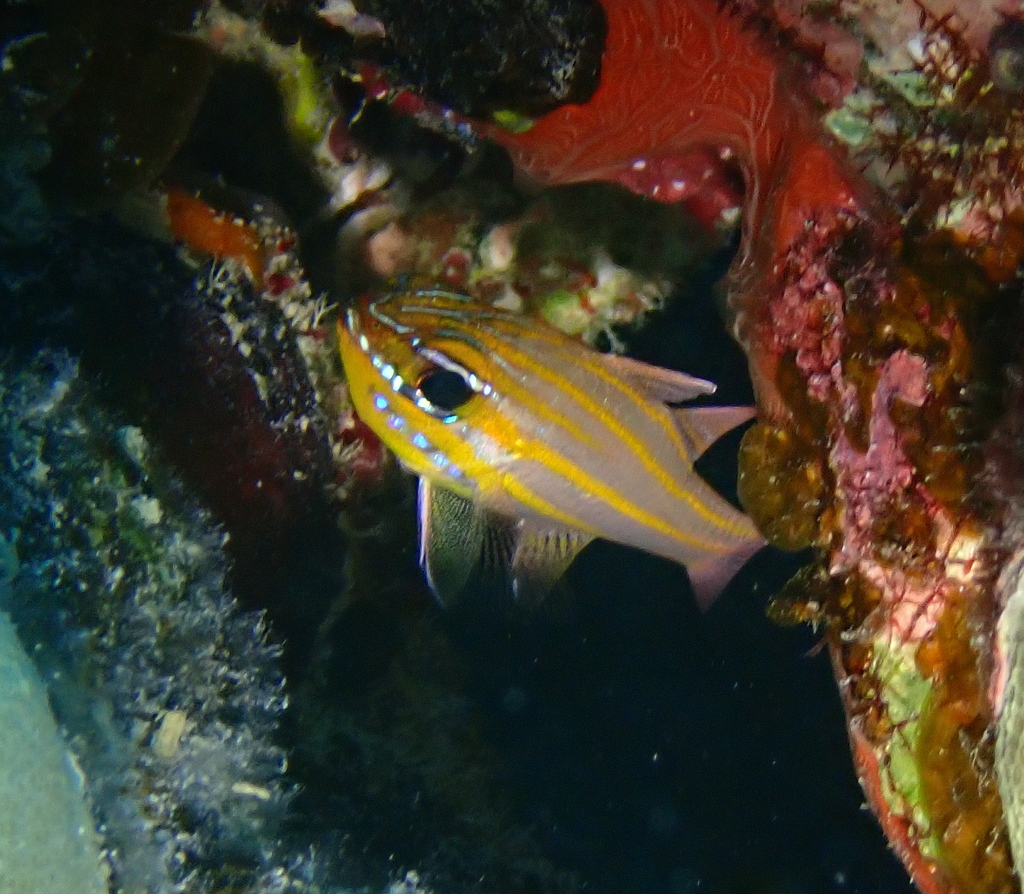 Blue-lined Cardinalfish
Ostorhinchus cyanosoma
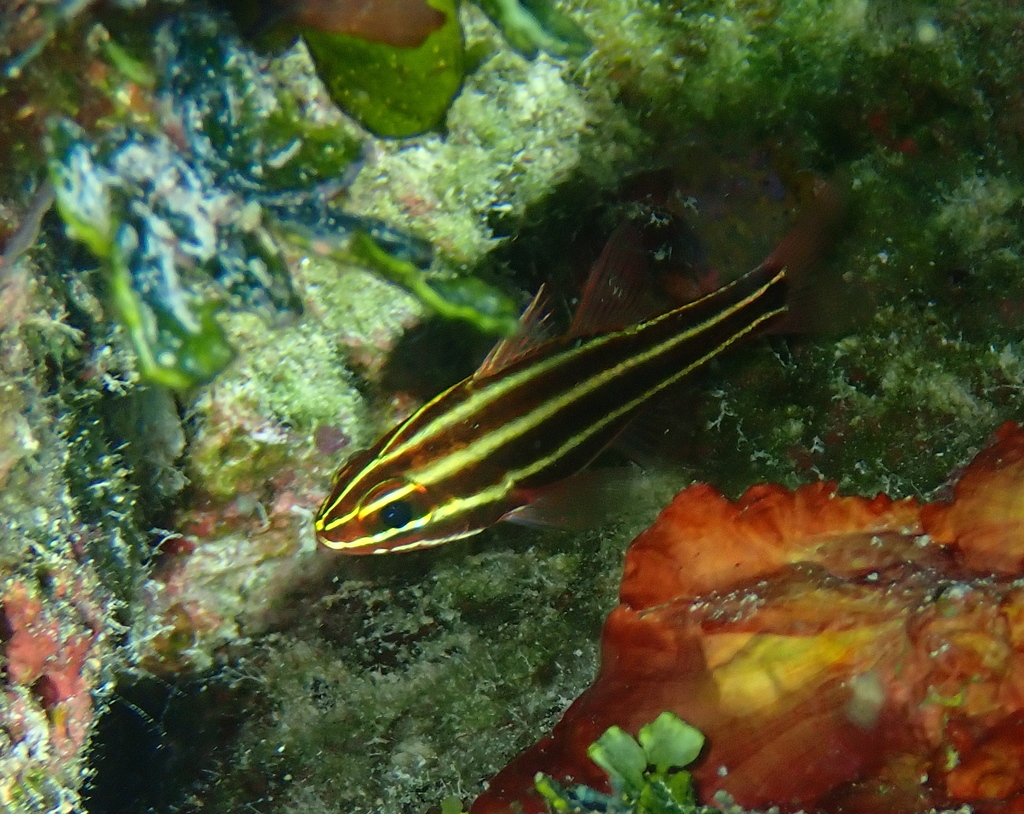 Blackbanded Soldierfish
Ostorhinchus nigrofasciatus
- Broadstriped Cardinalfish
Ostorhinchus angustatus
- Blackbanded Cardinal
Ostorhinchus cookii
Sources and credits
Names and taxonomy: WoRMS (CC BY 4.0) and the GBIF Backbone (CC BY 4.0). Photos: iNaturalist observers, each under the licence shown (CC0, CC BY or CC BY-SA).
- Depth, temperature, months and maps: records from OBIS and GBIF under CC0 or CC BY.
- Descriptions: Wikipedia, licensed CC BY-SA, each linked to its article.
- Conservation status as published by GBIF (IUCN Red List).
- 640 open-data records from 1911 to 2023.
Log what you see on your next dive
The free DiveHive diver app keeps your logbook with every sighting and shows what lives at the site you dive next.