
Orangetail filefish
Pervagor aspricaudus
- Usual depth6–23 m
- Water temperature24–29 °C
- Best monthsJanuary, August, and September
- How commonOccasional
About this species
Pervagor aspricaudus, also called orangetail filefish, is a marine fish in the family Monacanthidae. Its most striking feature derives from the vibrant colors of blue gray ombre, following a fade to an orange yellow on its fin, that gleam underwater.
Text from the Wikipedia article “Pervagor aspricaudus”, licensed CC BY-SA 4.0. Read the article
Where and when
Where it has been recorded
Worldwide
Loading the map
Best months
Worldwide (open data)
- January: 61 records
- February: 23 records
- March: 12 records
- April: 5 records
- May: 16 records
- June: 49 records
- July: 44 records
- August: 84 records
- September: 84 records
- October: 37 records
- November: 18 records
- December: 1 records
Depth and water temperature
Depth
Mostly recorded at 6–23 m · Deepest record: 29.2 m
Water temperature
Recorded in surface water of 24–29 °C
Names and classification
- English
- Orangetail filefish, lacefin filefish, Orange Filefish, Orange-tailed Leatherjacket, orangetail filefish, Orangetail Filefish, Orangetail Leatherjacket, Yellowtail Filefish
Names in 3 more languages
- French
- Poisson-lime à queue orange
- Japanese
- Jonsutonnishikikawahagi, ジョンストンニシキカワハギ
- Simplified Chinese
- 橘尾皮剝魨, 橘尾砲彈, 粗尾前角單棘魨, 粗尾前角魨
Other scientific names: Monacanthus aspricaudus, Monacanthus rubricauda
Similar species
- Blackbar filefish
Pervagor janthinosoma
- Redtail filefish
Pervagor melanocephalus
- Black-lined Filefish
Pervagor nigrolineatus
 Leatherjacket
Aluterus monoceros
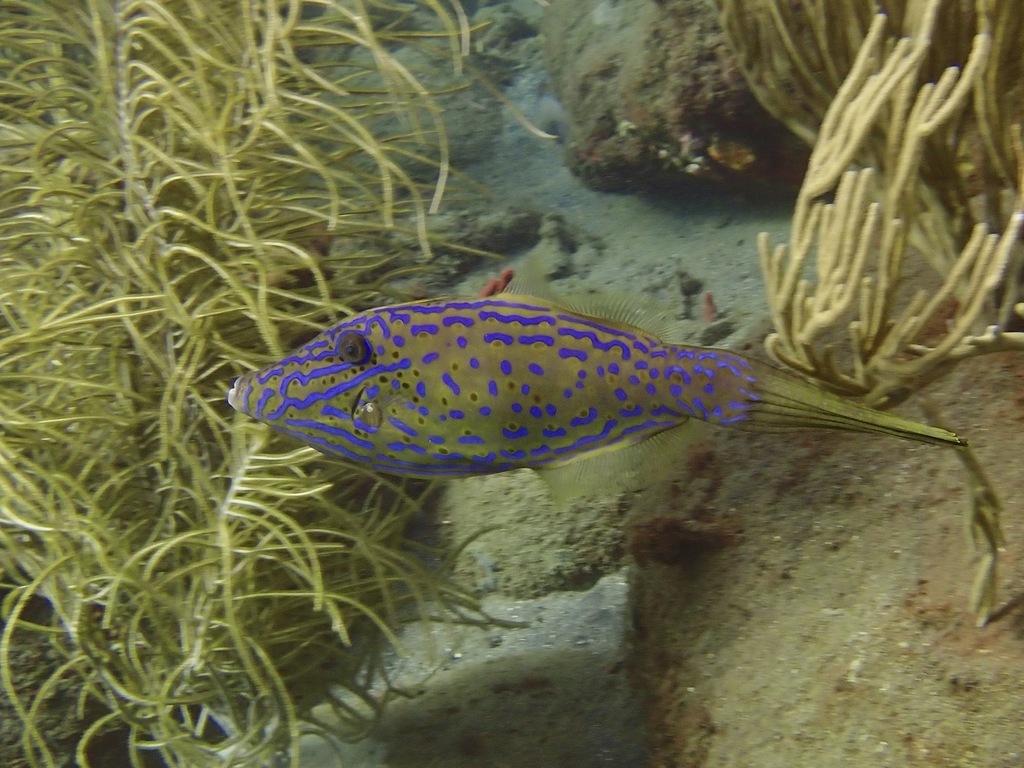 Scrawled filefish
Aluterus scriptus
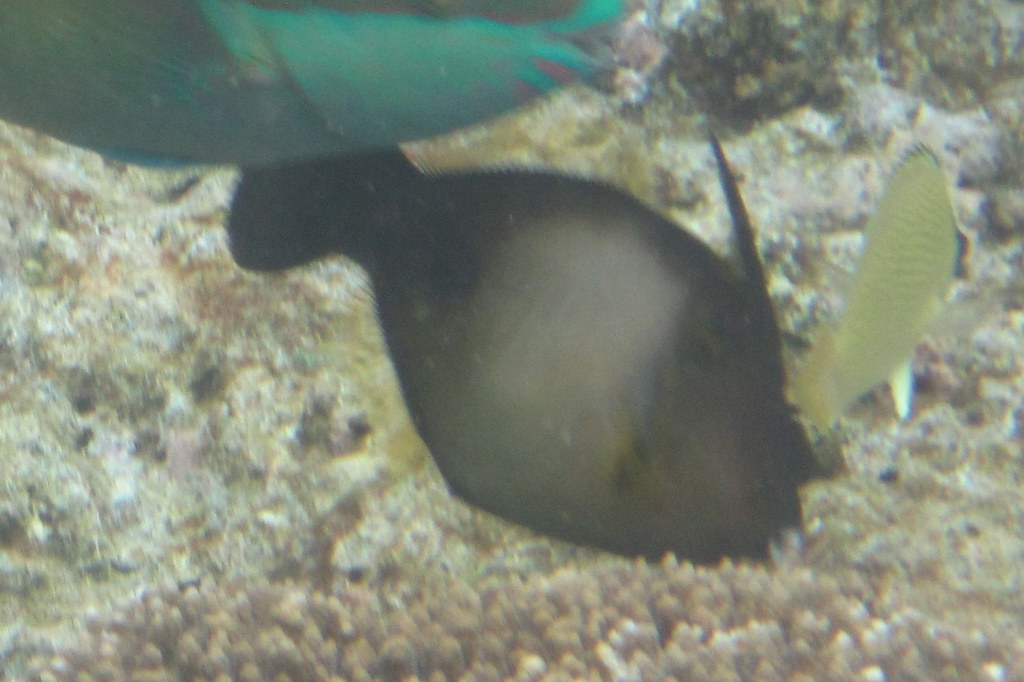 Broom filefish
Amanses scopas
Sources and credits
Names and taxonomy: WoRMS (CC BY 4.0) and the GBIF Backbone (CC BY 4.0). Photos: iNaturalist observers, each under the licence shown (CC0, CC BY or CC BY-SA).
- Depth, temperature, months and maps: records from OBIS and GBIF under CC0 or CC BY.
- Descriptions: Wikipedia, licensed CC BY-SA, each linked to its article.
- Conservation status as published by GBIF (IUCN Red List).
- 604 open-data records from 1854 to 2019.
Log what you see on your next dive
The free DiveHive diver app keeps your logbook with every sighting and shows what lives at the site you dive next.