
Iridescent Cardinalfish
Pristiapogon kallopterus
- Usual depth1–24 m
- Water temperature20–30 °C
- Best monthsMay, August, and October
- How commonOccasional
About this species
Pristiapogon is a genus of cardinalfishes native to the Indian and Pacific Oceans.
Text from the Wikipedia article “Pristiapogon”, licensed CC BY-SA 4.0. Read the article
Where and when
Where it has been recorded
Worldwide
Loading the map
Best months
Worldwide (open data)
- January: 81 records
- February: 71 records
- March: 61 records
- April: 111 records
- May: 174 records
- June: 100 records
- July: 143 records
- August: 187 records
- September: 151 records
- October: 214 records
- November: 168 records
- December: 42 records
Depth and water temperature
Depth
Mostly recorded at 1–24 m · Deepest record: 182.9 m
Water temperature
Recorded in surface water of 20–30 °C
Names and classification
- English
- Iridescent Cardinalfish, Kallopterus Cardinalfish, Saya de Malha Cardinalfish, Snyder's Cardinal, Spiny-head Cardinal, Spiny-head Cardinalfish, Spinyhead Cardinalfish
Names in 3 more languages
- French
- Apogon irisé, Cardinal à Dorsale Jaune, Poisson Cardinal
- Japanese
- Kasuriishimochi, カスリイシモチ
- Simplified Chinese
- 丽鳍棘眼天竺鲷, 大目側仔, 大面側仔, 棘頭天竺鯛, 麗鰭天竺鯛, 麗鰭鋸天竺鯛
Other scientific names: Apogon kallopterus, Apogon snyderi, Ostorhinchus kallopterus, Pristiapogon snyderi
Similar species
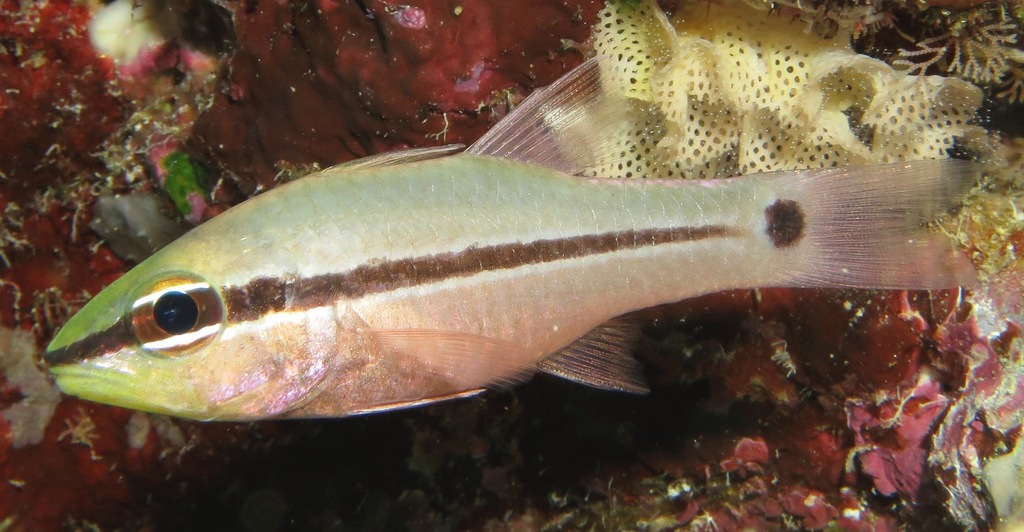 bridled cardinalfish
Pristiapogon fraenatus
- eyeshadow cardin
Pristiapogon exostigma
- Bandfin Cardinalfish
Pristiapogon taeniopterus
- Pearly-finned Cardinalfish
Jaydia poeciloptera
- Barred Striped Cardinalfish
Ostorhinchus fasciatus
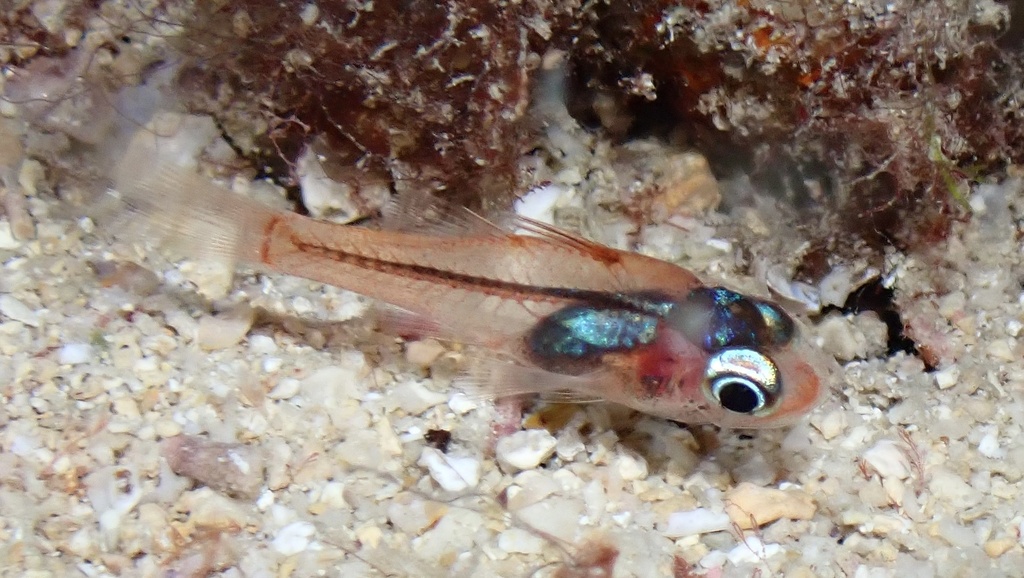 Cryptic Cardinalfish
Apogon erythrinus
Sources and credits
Names and taxonomy: WoRMS (CC BY 4.0) and the GBIF Backbone (CC BY 4.0). Photos: iNaturalist observers, each under the licence shown (CC0, CC BY or CC BY-SA).
- Depth, temperature, months and maps: records from OBIS and GBIF under CC0 or CC BY.
- Descriptions: Wikipedia, licensed CC BY-SA, each linked to its article.
- Conservation status as published by GBIF (IUCN Red List).
- 2,592 open-data records from 1856 to 2023.
Log what you see on your next dive
The free DiveHive diver app keeps your logbook with every sighting and shows what lives at the site you dive next.