
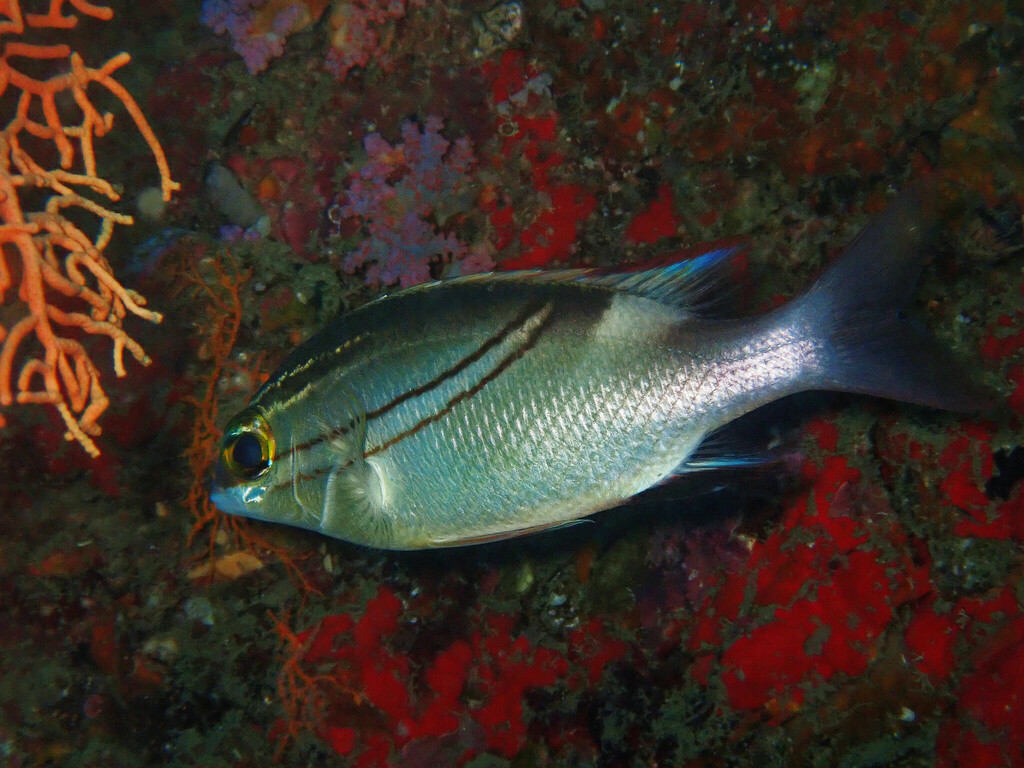
Bridled Monocle Bream
Scolopsis affinis
- Usual depth5–17 m
- Water temperature25–30 °C
- Best monthsJune
- How commonOccasional
About this species
Scolopsis affinis, the Peters' monocle bream, bridled monocle bream or yellowtail spinecheek, is a species of marine ray-finned fish belonging to the family Nemipteridae, the threadfin breams. This species is found in the Indian and Western Pacific Oceans.
Text from the Wikipedia article “Scolopsis affinis”, licensed CC BY-SA 4.0. Read the article
Where and when
Where it has been recorded
Worldwide
Loading the map
Best months
Worldwide (open data)
- January: 8 records
- February: 3 records
- March: 3 records
- April: 2 records
- May: 3 records
- June: 19 records
- July: 4 records
- August: 4 records
- September: 0 records
- October: 6 records
- November: 4 records
- December: 1 records
Depth and water temperature
Depth
Mostly recorded at 5–17 m · Deepest record: 34 m
Water temperature
Recorded in surface water of 25–30 °C
Names and classification
- English
- Bridled Monocle Bream, Large-eyed Spinecheek, Monocle Bream, Pale Monocle Bream, Peter's monocle bream, Peters' monocle bream, Spinecheek, Yellow-tail Spinecheek
Names in 6 more languages
- German
- Gelbschwanz-Scheinschnapper
- Filipino
- Buruba, Tagisang lawin
- French
- Scolopsis de Peter
- Japanese
- Himetamagashira, ヒメタマガシラ
- Thai
- ปลาทรายขาวแถบ
- Simplified Chinese
- 乌面眶棘鲈, 安芬眶棘鱸, 烏面眶棘鱸, 烏面眶棘鱸(近緣框棘鱸), 烏面赤尾冬, 紅尾冬仔
Similar species
 Bridled Monacle Bream
Scolopsis bilineata
- barred-face spine-cheek
Scolopsis monogramma
 Ciliate Spinecheek
Scolopsis ciliata
- Black-and-white Monocle Bream
Scolopsis lineata
- Barned-face Spine-cheek
Scolopsis margaritifera
- Lattice Monocle Bream
Scolopsis taenioptera
Sources and credits
Names and taxonomy: WoRMS (CC BY 4.0) and the GBIF Backbone (CC BY 4.0). Photos: iNaturalist observers, each under the licence shown (CC0, CC BY or CC BY-SA).
- Depth, temperature, months and maps: records from OBIS and GBIF under CC0 or CC BY.
- Descriptions: Wikipedia, licensed CC BY-SA, each linked to its article.
- Conservation status as published by GBIF (IUCN Red List).
- 270 open-data records from 1910 to 2019.
Log what you see on your next dive
The free DiveHive diver app keeps your logbook with every sighting and shows what lives at the site you dive next.