
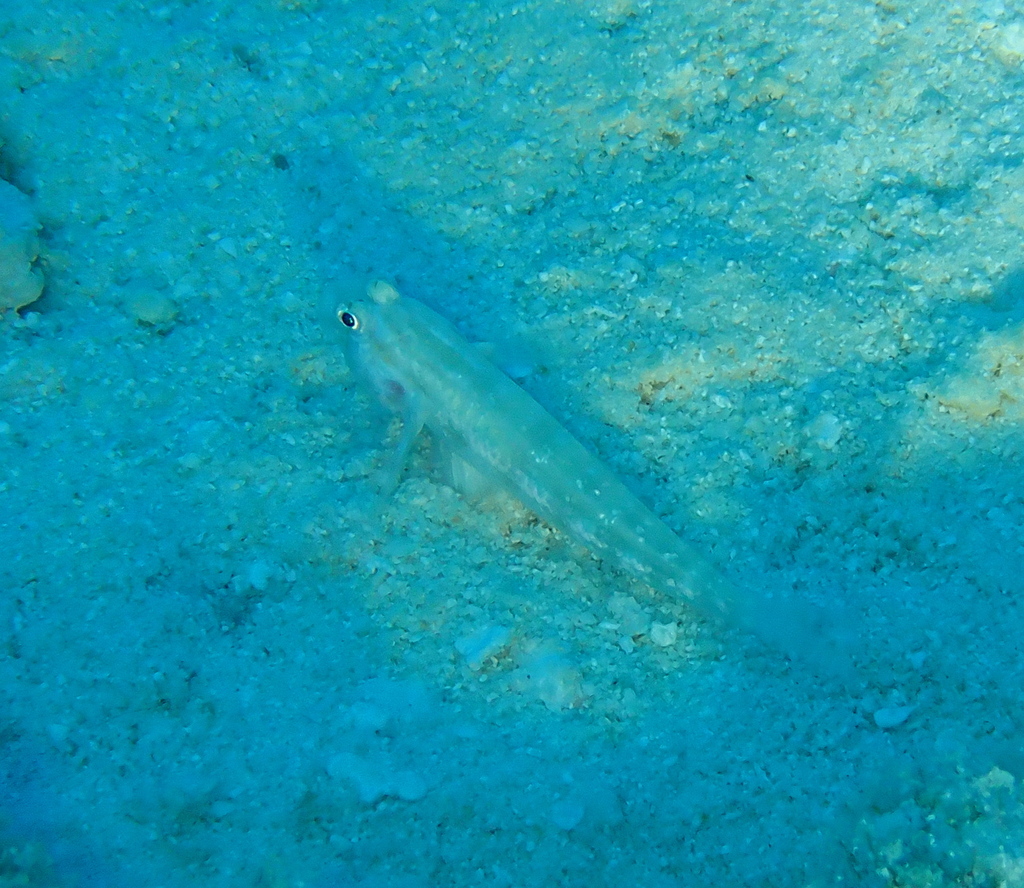
Blue Neon Goby
Stiphodon atropurpureus
- Water temperature29–29 °C
- Best monthsJune and August
- How commonRare
About this species
Stiphodon atropurpureus, commonly referred to as the Philippine neon goby or blue neon dwarf goby, is a ray-finned fish of the Gobiidae family. It is native to parts of Asia, including the Philippines, China, Japan, Vietnam and Indonesia.
Text from the Wikipedia article “Stiphodon atropurpureus”, licensed CC BY-SA 4.0. Read the article
Where and when
Where it has been recorded
Worldwide
Loading the map
Best months
Worldwide (open data)
- January: 0 records
- February: 0 records
- March: 0 records
- April: 0 records
- May: 0 records
- June: 3 records
- July: 0 records
- August: 3 records
- September: 0 records
- October: 0 records
- November: 1 records
- December: 0 records
Depth and water temperature
Water temperature
Recorded in surface water of 29–29 °C
Names and classification
- English
- Blue Neon Goby, Freshwater Neon Goby
Names in 2 more languages
- Japanese
- Konteribozuhaze, コンテリボウズハゼ
- Simplified Chinese
- 紫身枝牙鰕虎, 紫身枝牙鰕虎 (黑紫枝牙鰕虎), 紫身電光蝦虎, 菲律賓枝牙鰕虎, 藍唇霓虹蝦虎, 電光蝦虎, 黑紫枝牙鰕虎, 黑紫枝牙鰕虎魚
Other scientific names: Microsicydium atropurpureum, Microsicydium formosum, Stiphodon formosum
Similar species
 Eyebar goby
Gnatholepis cauerensis
- Yellowfin goby
Acanthogobius flavimanus
- Light-beige Goby
Acanthogobius lactipes
- Anjer Eye-bar Goby
Gnatholepis anjerensis
- Barred mudskipper
Periophthalmus argentilineatus
- Atlantic Mudskipper
Periophthalmus barbarus
Sources and credits
Names and taxonomy: WoRMS (CC BY 4.0) and the GBIF Backbone (CC BY 4.0). Photos: iNaturalist observers, each under the licence shown (CC0, CC BY or CC BY-SA).
- Depth, temperature, months and maps: records from OBIS and GBIF under CC0 or CC BY.
- Descriptions: Wikipedia, licensed CC BY-SA, each linked to its article.
- Conservation status as published by GBIF (IUCN Red List).
- 105 open-data records from 1931 to 1993.
Log what you see on your next dive
The free DiveHive diver app keeps your logbook with every sighting and shows what lives at the site you dive next.