
Giant tun
Tonna galea
- Usual depth24–73 m
- Water temperature18–29 °C
- Best monthsJune, July, and September
- How commonOccasional
About this species
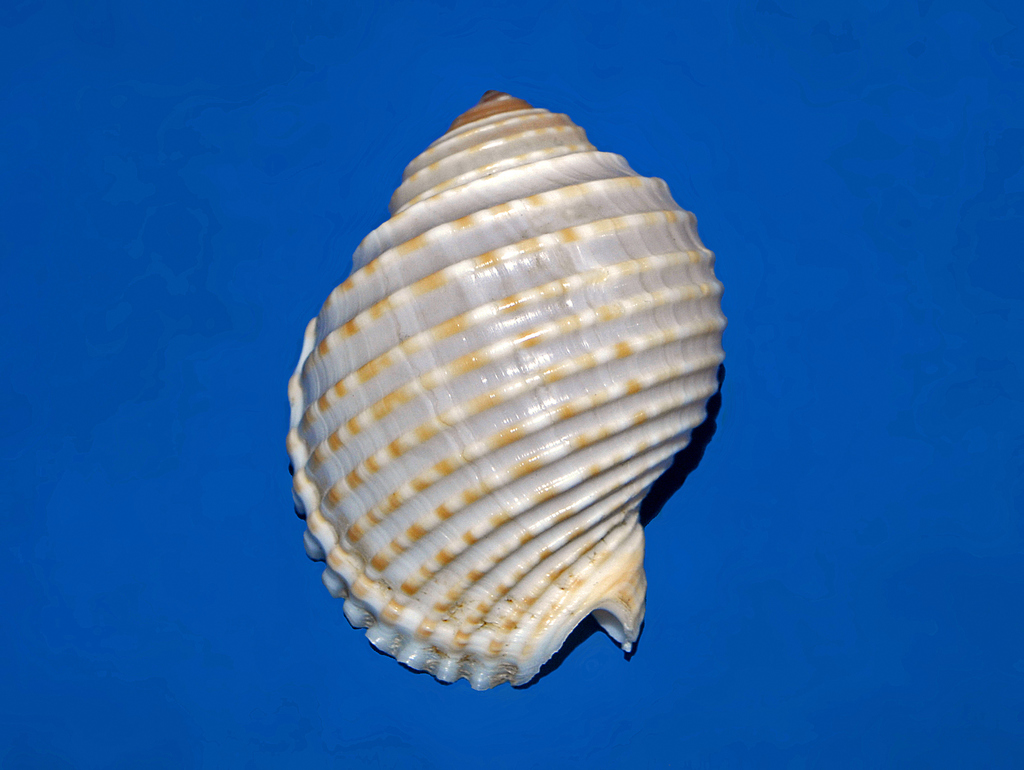
Tonna galea, commonly known as the giant tun, is a species of marine gastropod mollusc in the family Tonnidae. This very large sea snail or tun snail is found in the North Atlantic Ocean as far as the coast of West Africa, in the Mediterranean Sea and the Caribbean Sea. The species was first described by Carl Linnaeus in 1758.
Text from the Wikipedia article “Tonna galea”, licensed CC BY-SA 4.0. Read the article
Where and when
Where it has been recorded
Worldwide
Loading the map
Best months
Worldwide (open data)
- January: 9 records
- February: 15 records
- March: 19 records
- April: 25 records
- May: 22 records
- June: 46 records
- July: 28 records
- August: 24 records
- September: 29 records
- October: 20 records
- November: 19 records
- December: 11 records
Depth and water temperature
Depth
Mostly recorded at 24–73 m · Deepest record: 200 m
Water temperature
Recorded in surface water of 18–29 °C
Names and classification
- English
- Giant tun, Tun shell, giant tun, Giant Tun, tun shell
Names in 3 more languages
- German
- Große Fassschnecke, Große Faßschnecke
- Spanish
- caracol tonel
- French
- dólium geant, tonne cannelée
Other scientific names: Buccinum galea, Buccinum olearium, Cadium galea, Cadium olearium, Cadus galea, Dolium (Dolium) galea, Dolium (Dolium) modjokasriense, Dolium antillarum, Dolium epidermata, Dolium galea, Dolium galeatum, Dolium modjokasriense, Dolium olearium, Dolium sagrae, Dolium tardina, Dolium tenue, Malea galea, Tonna (Tonna) galea, Tonna olearium
Similar species
- Pacific partridge tun
Tonna perdix
- Costate tun
Tonna allium
- Banded tun
Tonna sulcosa
Sources and credits
Names and taxonomy: WoRMS (CC BY 4.0) and the GBIF Backbone (CC BY 4.0). Photos: iNaturalist observers, each under the licence shown (CC0, CC BY or CC BY-SA).
- Depth, temperature, months and maps: records from OBIS and GBIF under CC0 or CC BY.
- Descriptions: Wikipedia, licensed CC BY-SA, each linked to its article.
- Conservation status as published by GBIF (IUCN Red List).
- 723 open-data records from 1758 to 2020.
Log what you see on your next dive
The free DiveHive diver app keeps your logbook with every sighting and shows what lives at the site you dive next.