
Burrowing goby
Trypauchen vagina
- Usual depth1–28 m
- Water temperature20–30 °C
- Best monthsJanuary, April, and May
- How commonRare
About this species
Trypauchen vagina, commonly known as the burrowing goby, is a species of eel goby found in the Indo-Pacific region. It has an elongated body about 20 to 22 cm in length. It is reddish-pink in color and possesses distinctive pouches in the upper edges of its gill covers. It lives in burrows in the silty and muddy bottoms of its marine and brackish habitats. It has reduced eyes that are entirely covered with skin and the anterior portion of its head is protected by thick flesh. Both adaptations aid it in digging its burrows.
Text from the Wikipedia article “Trypauchen vagina”, licensed CC BY-SA 4.0. Read the article
Where and when
Where it has been recorded
Worldwide
Loading the map
Best months
Worldwide (open data)
- January: 3 records
- February: 0 records
- March: 1 records
- April: 3 records
- May: 3 records
- June: 0 records
- July: 2 records
- August: 2 records
- September: 0 records
- October: 1 records
- November: 1 records
- December: 0 records
Depth and water temperature
Depth
Mostly recorded at 1–28 m · Deepest record: 28.3 m
Water temperature
Recorded in surface water of 20–30 °C
Names and classification
- English
- Burrowing goby, Indo-pacific Burrowing Goby, Pink Mud Goby, Red Goby
Names in 3 more languages
- Japanese
- テンジクアカウオ
- Thai
- ปลาเขือ
- Simplified Chinese
- 孔鰕虎, 孔鰕虎魚
Other scientific names: Gobioides ruber, Gobius vagina, Trypauchen wakae
Similar species
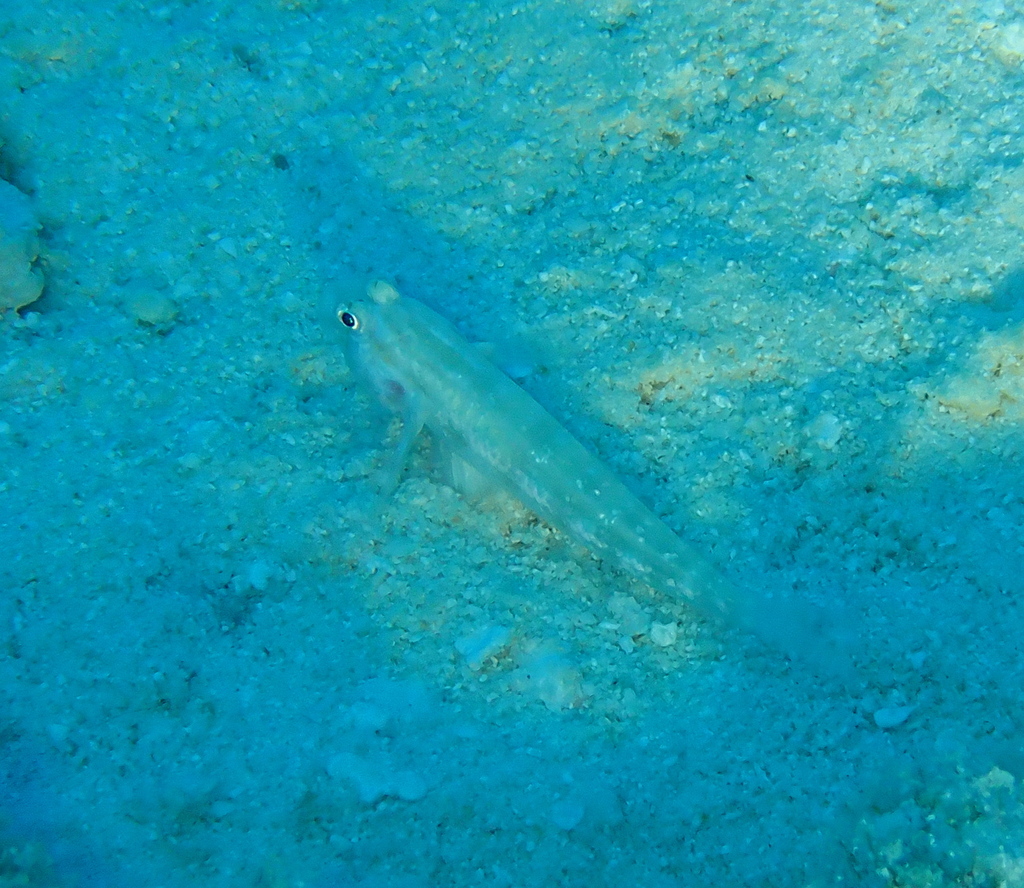 Eyebar goby
Gnatholepis cauerensis
- Yellowfin goby
Acanthogobius flavimanus
- Light-beige Goby
Acanthogobius lactipes
- Anjer Eye-bar Goby
Gnatholepis anjerensis
- Barred mudskipper
Periophthalmus argentilineatus
- Atlantic Mudskipper
Periophthalmus barbarus
Sources and credits
Names and taxonomy: WoRMS (CC BY 4.0) and the GBIF Backbone (CC BY 4.0). Photos: iNaturalist observers, each under the licence shown (CC0, CC BY or CC BY-SA).
- Depth, temperature, months and maps: records from OBIS and GBIF under CC0 or CC BY.
- Descriptions: Wikipedia, licensed CC BY-SA, each linked to its article.
- Conservation status as published by GBIF (IUCN Red List).
- 212 open-data records from 1801 to 2025.
Log what you see on your next dive
The free DiveHive diver app keeps your logbook with every sighting and shows what lives at the site you dive next.