
Large-eye Conger
Ariosoma marginatum
- Usual depth8–450 m
- Water temperature24–26 °C
- Best monthsNovember
- How commonRare
About this species
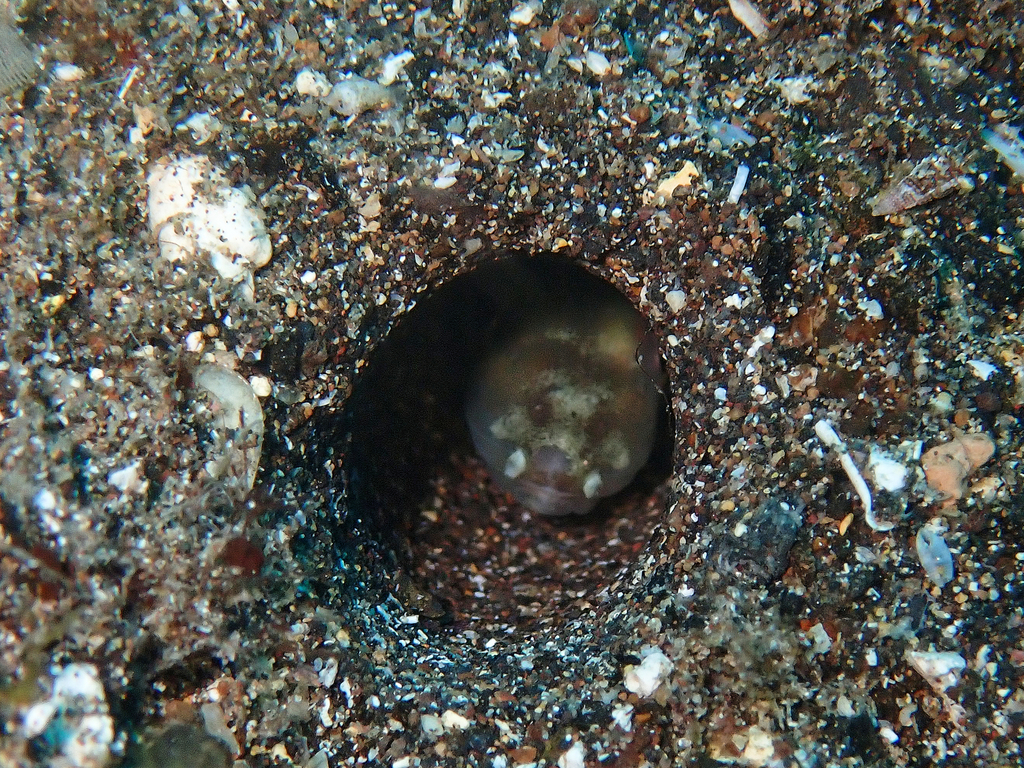
The large-eye conger is an eel in the family Congridae. This fish also goes by the name puhi. Ariosoma marginatum and other conger eels are also called White Eels in the Hawaiian Islands. It was described by Léon Vaillant and Henri Émile Sauvage in 1875, originally under the genus Congrogadus. It is a tropical, marine eel which is known from the northwestern and eastern central Pacific Ocean, including Hawaii and the Ladd Seamount.
Text from the Wikipedia article “Large-eye conger”, licensed CC BY-SA 4.0. Read the article
Where and when
Where it has been recorded
Worldwide
Loading the map
Best months
Worldwide (open data)
- January: 0 records
- February: 0 records
- March: 1 records
- April: 3 records
- May: 4 records
- June: 1 records
- July: 3 records
- August: 1 records
- September: 1 records
- October: 4 records
- November: 10 records
- December: 0 records
Depth and water temperature
Depth
Mostly recorded at 8–450 m · Deepest record: 645 m
Water temperature
Recorded in surface water of 24–26 °C
Names and classification
- English
- Large-eye Conger
Other scientific names: Ariosoma bowersi, Congrellus bowersi, Congrogadus marginatus
Similar species
 Bandtooth conger
Ariosoma balearicum
- Darkfin Conger
Ariosoma anago
- Big-eye Conger
Ariosoma anagoides
- Lord Howe Conger
Ariosoma howense
- Mottled Conger
Ariosoma kapala
Sources and credits
Names and taxonomy: WoRMS (CC BY 4.0) and the GBIF Backbone (CC BY 4.0). Photos: iNaturalist observers, each under the licence shown (CC0, CC BY or CC BY-SA).
- Depth, temperature, months and maps: records from OBIS and GBIF under CC0 or CC BY.
- Descriptions: Wikipedia, licensed CC BY-SA, each linked to its article.
- Conservation status as published by GBIF (IUCN Red List).
- 85 open-data records from 1889 to 2006.
- Species data updated October 27, 2026.
Log what you see on your next dive
The free DiveHive diver app keeps your logbook with every sighting and shows what lives at the site you dive next.