
Common Dragonet
Callionymus enneactis
- Usual depth1–123 m
- Water temperature19–30 °C
- Best monthsOctober
- How commonOccasional
About this species
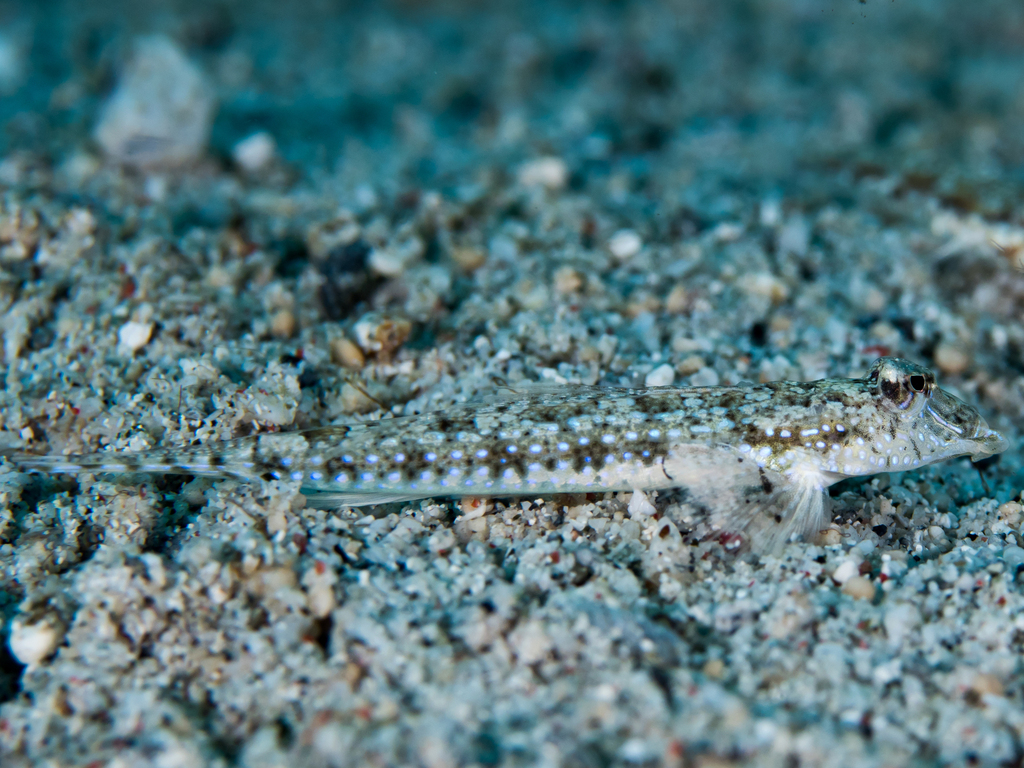
Callionymus enneactis, the mangrove dragonet or common dragonet, is a species of dragonet native to the western Pacific Ocean at depths down to 15 metres (49 ft). At shallower depths it occurs in areas of mangroves, being found on coral reefs at deeper depths. This species grows to a length of 8 centimetres (3.1 in) TL.
Text from the Wikipedia article “Callionymus enneactis”, licensed CC BY-SA 4.0. Read the article
Where and when
Where it has been recorded
Worldwide
Loading the map
Best months
Worldwide (open data)
- January: 18 records
- February: 26 records
- March: 10 records
- April: 13 records
- May: 20 records
- June: 17 records
- July: 16 records
- August: 20 records
- September: 18 records
- October: 92 records
- November: 21 records
- December: 14 records
Depth and water temperature
Depth
Mostly recorded at 1–123 m · Deepest record: 123.3 m
Water temperature
Recorded in surface water of 19–30 °C
Names and classification
- English
- Common Dragonet, Mangrove Dragonet
Names in 2 more languages
- Japanese
- コガタハナビヌメリ, ハナビヌメリ
- Simplified Chinese
- 斑鰭, 狗圻, 老鼠
Other scientific names: Callionymus altidorsalis, Callionymus calliste, Callionymus distethommatus, Callionymus enneatics, Callionymus wilburi, Paradiplogrammus distethommatus, Paradiplogrammus enneactis, Paradiplogrammus parvus
Similar species
- Blotchfin dragonet
Callionymus filamentosus
 Sidespotted Dragonet
Callionymus pleurostictus
- Günther's Deepwater Dragonet
Callionymus guentheri
- Hildegard's Dragonet
Callionymus hildae
- Japanese dragonet
Callionymus japonicus
- Eightspot Dragonet
Callionymus octostigmatus
Sources and credits
Names and taxonomy: WoRMS (CC BY 4.0) and the GBIF Backbone (CC BY 4.0). Photos: iNaturalist observers, each under the licence shown (CC0, CC BY or CC BY-SA).
- Depth, temperature, months and maps: records from OBIS and GBIF under CC0 or CC BY.
- Descriptions: Wikipedia, licensed CC BY-SA, each linked to its article.
- Conservation status as published by GBIF (IUCN Red List).
- 386 open-data records from 1879 to 2023.
- Species data updated October 26, 2026.
Log what you see on your next dive
The free DiveHive diver app keeps your logbook with every sighting and shows what lives at the site you dive next.