
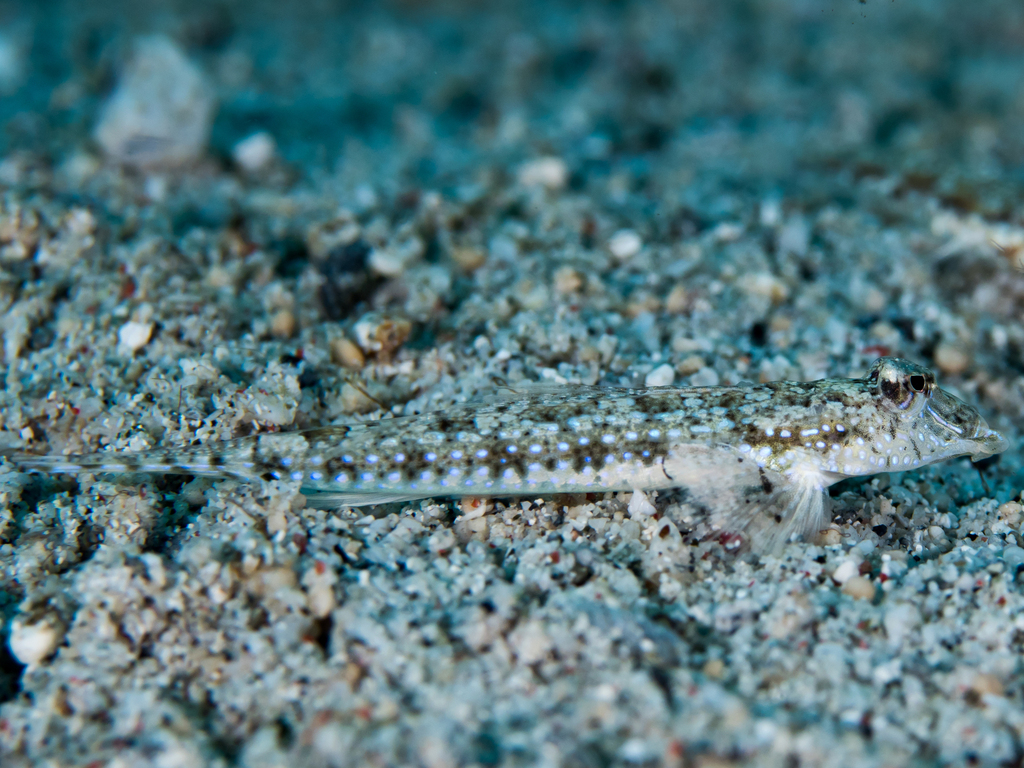
Blotchfin dragonet
Callionymus filamentosus
- Usual depth9–40 m
- Water temperature20–29 °C
- Best monthsApril, August, and November
- How commonOccasional
About this species
The blotchfin dragonet is a species of dragonet native to the Indian Ocean and the western Pacific Ocean. It also now occurs in the Mediterranean Sea, where it was first recorded in 1953 off Israel. It has since been observed in Cyprus, Lebanon, Turkey and Rhodes (Greece). This species occurs at depths from 16 to 350 m and can grows to a length of 20 cm.
Text from the Wikipedia article “Blotchfin dragonet”, licensed CC BY-SA 4.0. Read the article
Where and when
Where it has been recorded
Worldwide
Loading the map
Best months
Worldwide (open data)
- January: 24 records
- February: 23 records
- March: 27 records
- April: 30 records
- May: 27 records
- June: 16 records
- July: 17 records
- August: 41 records
- September: 27 records
- October: 23 records
- November: 29 records
- December: 17 records
Depth and water temperature
Depth
Mostly recorded at 9–40 m · Deepest record: 305 m
Water temperature
Recorded in surface water of 20–29 °C
Names and classification
- English
- Blotchfin dragonet, blotchfin dragonet, Blotchfin Dragonet
Names in 3 more languages
- French
- Dragonnet à tache noire, Dragonnet de Haifa, Dragonnet de Mer Rouge
- Thai
- ปลามังกรน้อยครีบเส้น
- Simplified Chinese
- 單絲, 狗圻, 絲鰭, 老鼠
Other scientific names: Callionymus filentosus, Callionymus haifae, Callionymus stigmapteron, Calliurichthys filamentosus, Repomucenus filamentosus
Similar species
- Common Dragonet
Callionymus enneactis
 Sidespotted Dragonet
Callionymus pleurostictus
- Günther's Deepwater Dragonet
Callionymus guentheri
- Hildegard's Dragonet
Callionymus hildae
- Japanese dragonet
Callionymus japonicus
- Eightspot Dragonet
Callionymus octostigmatus
Sources and credits
Names and taxonomy: WoRMS (CC BY 4.0) and the GBIF Backbone (CC BY 4.0). Photos: iNaturalist observers, each under the licence shown (CC0, CC BY or CC BY-SA).
- Depth, temperature, months and maps: records from OBIS and GBIF under CC0 or CC BY.
- Descriptions: Wikipedia, licensed CC BY-SA, each linked to its article.
- Conservation status as published by GBIF (IUCN Red List).
- 442 open-data records from 1837 to 2024.
- Species data updated October 26, 2026.
Log what you see on your next dive
The free DiveHive diver app keeps your logbook with every sighting and shows what lives at the site you dive next.