
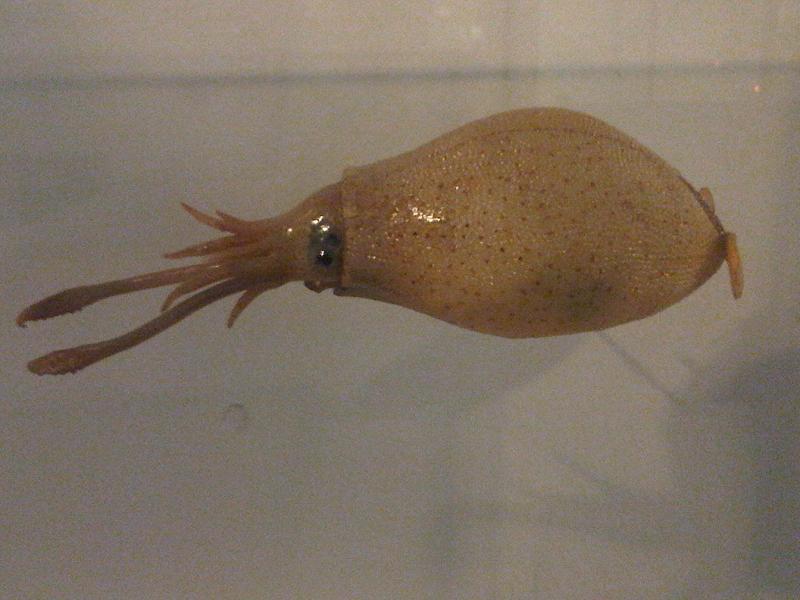
Cockatoo squid
Cranchia scabra
- Usual depth28–1,000 m
- Water temperature-1–29 °C
- Best monthsJanuary, February, and May
- How commonOccasional
Photo credit: (c) Emőke Dénes, some rights reserved (CC BY-SA) · CC BY-SA · iNaturalist
About this species
Cranchia scabra is a species of glass squid, sometimes called the rough glass squid. It is the only species in the genus, and is fairly small. They reside in the epipelagic zones of the tropical Atlantic. The genus Cranchia is named after John Cranch who first described this species; it has subsequently become the type genus of its family.
Text from the Wikipedia article “Cranchia scabra”, licensed CC BY-SA 4.0. Read the article
Where and when
Where it has been recorded
Worldwide
Loading the map
Best months
Worldwide (open data)
- January: 27 records
- February: 44 records
- March: 21 records
- April: 18 records
- May: 35 records
- June: 25 records
- July: 6 records
- August: 19 records
- September: 16 records
- October: 16 records
- November: 13 records
- December: 13 records
Depth and water temperature
Depth
Mostly recorded at 28–1,000 m · Deepest record: 3,655 m
Water temperature
Recorded in surface water of -1–29 °C
Names and classification
- English
- Cockatoo squid, Rough cranch squid, cockatoo squid, Glass squid, Rough Glass Squid
Names in 7 more languages
- German
- Warziger Gallertschirm
- Spanish
- Calamar de cristal áspero, Cranquiluria ruda
- French
- Encornet-outre rude
- Japanese
- サメハダホウズキイカ, サメハダボウズキイカ
- Korean
- 악어가죽주머니오징어
- Thai
- ปลาหมึกแก้วหนังหยาบ
- Simplified Chinese
- Xiăo-Tóu-Yóu, 小頭魷
Other scientific names: Cranchia hispida, Cranchia tenuitentaculeta, Loligo cranchii, Octopus (Philonexis) eylais, Octopus eylais, Philonexis eylais
Similar species
- Deepsea squid
Bathothauma lyromma
Sources and credits
Names and taxonomy: WoRMS (CC BY 4.0) and the GBIF Backbone (CC BY 4.0). Photos: iNaturalist observers, each under the licence shown (CC0, CC BY or CC BY-SA).
- Depth, temperature, months and maps: records from OBIS and GBIF under CC0 or CC BY.
- Descriptions: Wikipedia, licensed CC BY-SA, each linked to its article.
- Conservation status as published by GBIF (IUCN Red List).
- 912 open-data records from 1908 to 2022.
- Species data updated November 1, 2026.
Log what you see on your next dive
The free DiveHive diver app keeps your logbook with every sighting and shows what lives at the site you dive next.