
Barred snailfish
Crystallias matsushimae
- Usual depth0–416 m
- Water temperature7–19 °C
- Best monthsMay
- How commonRare
About this species
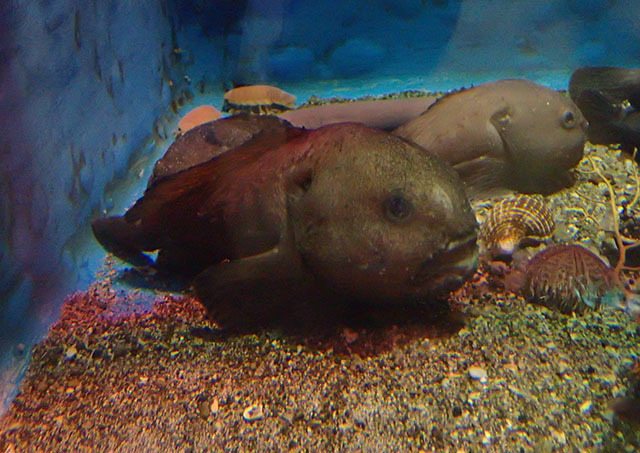
Crystallias is a monospecific genus of marine ray-finned fish belonging to the family Liparidae. It only species, Crystallias matsushimae, the barred snailfish, is found in the northwestern Pacific Ocean, from the Sea of Japan and the Pacific coast of Honshu to the Bering Sea. It is found at depths of from 30 to 700 metres. This species can grows up to a length of 38 centimetres (15 in) TL.
Text from the Wikipedia article “Crystallias”, licensed CC BY-SA 4.0. Read the article
Where and when
Where it has been recorded
Worldwide
Loading the map
Best months
Worldwide (open data)
- January: 0 records
- February: 1 records
- March: 0 records
- April: 0 records
- May: 11 records
- June: 2 records
- July: 4 records
- August: 3 records
- September: 1 records
- October: 3 records
- November: 3 records
- December: 0 records
Depth and water temperature
Depth
Mostly recorded at 0–416 m · Deepest record: 505.5 m
Water temperature
Recorded in surface water of 7–19 °C
Names and classification
- English
- Barred snailfish, Bearded snailfish, Tiger Snailfish
Names in 2 more languages
- Japanese
- Abachan, アバチャン
- Korean
- 물미거지
Other scientific names: Crystallias kamoae, Crystallichthys matsushimae
Similar species
 Pink snailfish
Careproctus rastrinus
 Rough-body snailfish
Careproctus trachysoma
- Blackfinned snailfish
Careproctus cypselurus
- Blunt-tooth Snailfish
Careproctus paxtoni
Sources and credits
Names and taxonomy: WoRMS (CC BY 4.0) and the GBIF Backbone (CC BY 4.0). Photos: iNaturalist observers, each under the licence shown (CC0, CC BY or CC BY-SA).
- Depth, temperature, months and maps: records from OBIS and GBIF under CC0 or CC BY.
- Descriptions: Wikipedia, licensed CC BY-SA, each linked to its article.
- Conservation status as published by GBIF (IUCN Red List).
- 167 open-data records from 1906 to 2011.
- Species data updated November 1, 2026.
Log what you see on your next dive
The free DiveHive diver app keeps your logbook with every sighting and shows what lives at the site you dive next.