
DiscoverSpeciesSharks and rays
Phallic Catshark
Galeus priapus
- Usual depth307–769 m
- Water temperature24–28 °C
- Best monthsMarch and December
- How commonRare
About this species
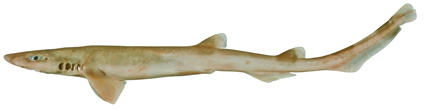
The phallic catshark is a species of shark belonging to the family Pentanchidae, the deepwater catsharks. It is found on or near the ocean floor, in the deep waters off New Caledonia and Vanuatu. A slender species attaining a length of 46 cm (18 in), it is characterized by a long caudal fin bearing a crest of enlarged dermal denticles along the dorsal margin, and very long claspers in adult males. This shark is gray-colored, with four dark saddles along the back and tail.
Text from the Wikipedia article “Phallic catshark”, licensed CC BY-SA 4.0. Read the article
Where and when
Where it has been recorded
Worldwide
Loading the map
Best months
Worldwide (open data)
- January: 0 records
- February: 0 records
- March: 4 records
- April: 0 records
- May: 0 records
- June: 0 records
- July: 0 records
- August: 0 records
- September: 0 records
- October: 1 records
- November: 0 records
- December: 4 records
Depth and water temperature
Depth
Mostly recorded at 307–769 m · Deepest record: 769 m
Water temperature
Recorded in surface water of 24–28 °C
Names and classification
- English
- Phallic Catshark
Names in 1 more languages
- French
- Chien Priape
Similar species
 Slender Sawtail Catshark
Galeus gracilis
- Corrigan's Catshark
Galeus corriganae
- gecko catshark
Galeus eastmani
- Longnose Sawtail Catshark
Galeus longirostris
- broadfin sawtail catshark
Galeus nipponensis
- blacktip sawtail catshark
Galeus sauteri
Sources and credits
Names and taxonomy: WoRMS (CC BY 4.0) and the GBIF Backbone (CC BY 4.0). Photos: iNaturalist observers, each under the licence shown (CC0, CC BY or CC BY-SA).
- Depth, temperature, months and maps: records from OBIS and GBIF under CC0 or CC BY.
- Descriptions: Wikipedia, licensed CC BY-SA, each linked to its article.
- Conservation status as published by GBIF (IUCN Red List).
- 17 open-data records from 1993 to 1994.
- Species data updated November 2, 2026.
Log what you see on your next dive
The free DiveHive diver app keeps your logbook with every sighting and shows what lives at the site you dive next.