
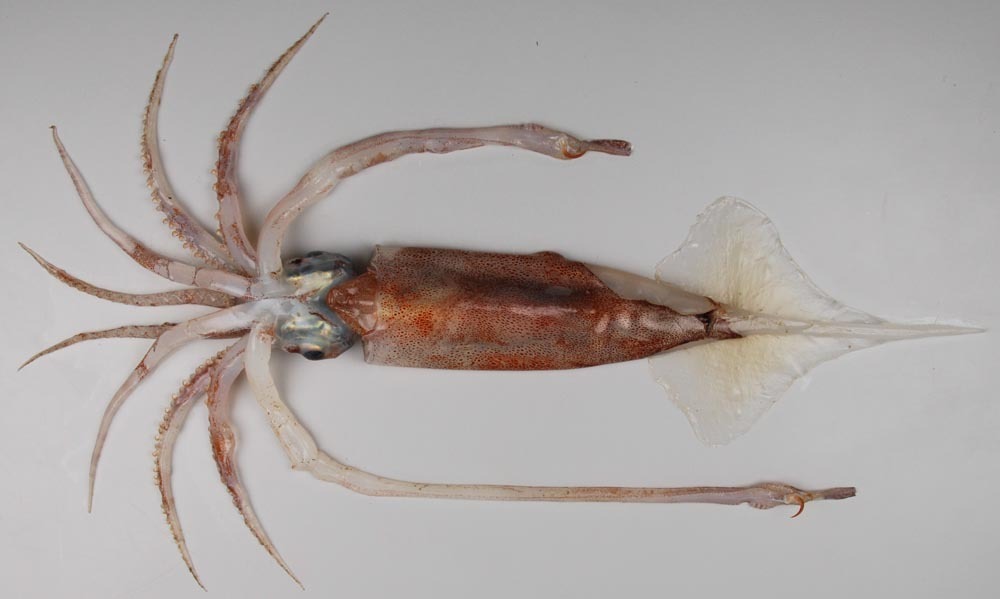
Antarctic Gonate Squid
Gonatus antarcticus
- Usual depth350–1,991 m
- Water temperature-2–18 °C
- Best monthsFebruary
- How commonRare
Photo credit: (c) Darren Stevens, some rights reserved (CC BY) · CC BY · iNaturalist
About this species
Gonatus antarcticus is a squid in the family Gonatidae. The species is known with certainty only from southern Atlantic waters but it may have a circum-Antarctic distribution. Historically, G. antarcticus was known to scientists only from dead specimens caught by fishermen and remains found in the bellies of larger animals. However, in December 2024, a free-swimming live squid was captured on video at 7,000 feet by a remotely operated vehicle owned by the Schmidt Ocean Institute making a film for National Geographic.
Text from the Wikipedia article “Gonatus antarcticus”, licensed CC BY-SA 4.0. Read the article
Where and when
Where it has been recorded
Worldwide
Loading the map
Best months
Worldwide (open data)
- January: 15 records
- February: 219 records
- March: 13 records
- April: 0 records
- May: 9 records
- June: 5 records
- July: 47 records
- August: 8 records
- September: 3 records
- October: 59 records
- November: 16 records
- December: 3 records
Depth and water temperature
Depth
Mostly recorded at 350–1,991 m · Deepest record: 2,613 m
Water temperature
Recorded in surface water of -2–18 °C
Names and classification
- English
- Antarctic Gonate Squid
Names in 1 more languages
- Japanese
- ナンキョクテカギイカ
Sources and credits
Names and taxonomy: WoRMS (CC BY 4.0) and the GBIF Backbone (CC BY 4.0). Photos: iNaturalist observers, each under the licence shown (CC0, CC BY or CC BY-SA).
- Depth, temperature, months and maps: records from OBIS and GBIF under CC0 or CC BY.
- Descriptions: Wikipedia, licensed CC BY-SA, each linked to its article.
- Conservation status as published by GBIF (IUCN Red List).
- 405 open-data records from 1945 to 2024.
- Species data updated November 3, 2026.
Log what you see on your next dive
The free DiveHive diver app keeps your logbook with every sighting and shows what lives at the site you dive next.