
DiscoverSpeciesCorals and anemones
Smooth bum coral
Heteropsammia cochlea
- Usual depth23–290 m
- Water temperature21–29 °C
- Best monthsFebruary, May, and November
- How commonOccasional
About this species
Heteropsammia cochlea, also known as walking dendro, is a species of small solitary coral in the family Dendrophylliidae that is native to the Indo-Pacific area.
Text from the Wikipedia article “Heteropsammia cochlea”, licensed CC BY-SA 4.0. Read the article
Where and when
Where it has been recorded
Worldwide
Loading the map
Best months
Worldwide (open data)
- January: 27 records
- February: 70 records
- March: 19 records
- April: 15 records
- May: 48 records
- June: 31 records
- July: 12 records
- August: 4 records
- September: 34 records
- October: 19 records
- November: 50 records
- December: 11 records
Depth and water temperature
Depth
Mostly recorded at 23–290 m · Deepest record: 675.5 m
Water temperature
Recorded in surface water of 21–29 °C
Names and classification
- English
- Smooth bum coral, smooth bum coral, Walking Dendro
Names in 3 more languages
- French
- Dent de cochon en huit
- Japanese
- スツボサンゴ
- Simplified Chinese
- 螺形歧異沙珊瑚
Other scientific names: Heteropsammia aphrodes, Heteropsammia michelinii, Heteropsammia ovalis, Heteropsammia pisum, Heteropsammia rotundata, Madrepora cochlea, Psammoseris cylicioides
Similar species
- Smooth bum coral
Heteropsammia eupsammides
- Beaked stony coral
Enallopsammia rostrata
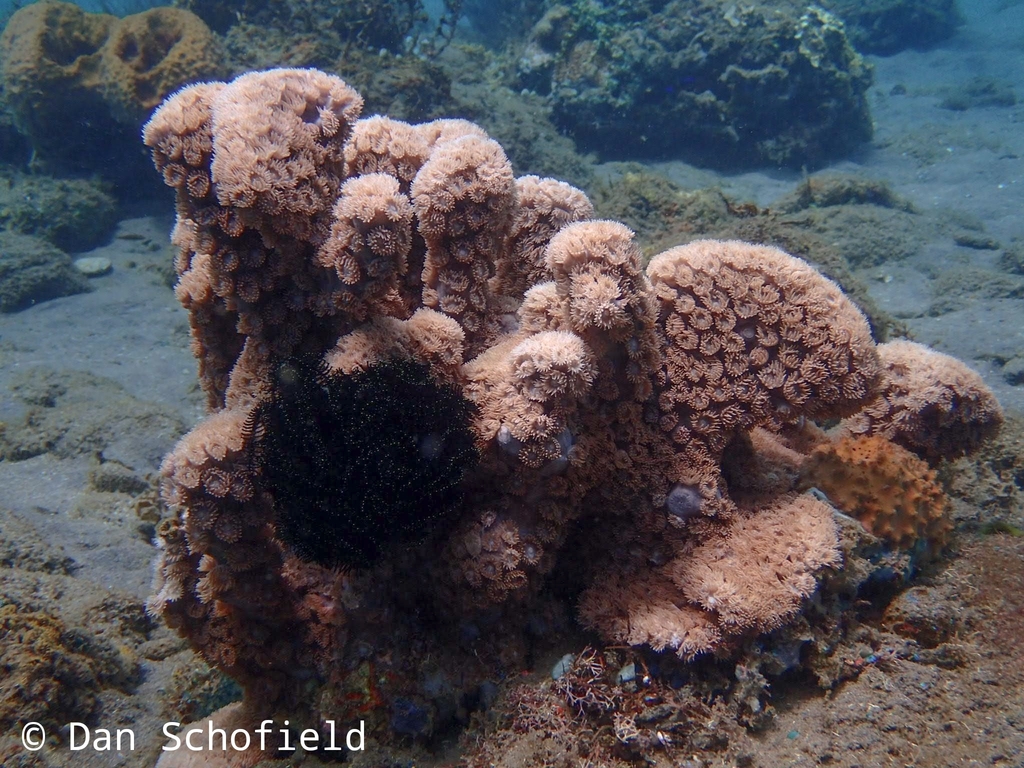 Bowl coral
Duncanopsammia peltata
- Orange cup coral
Tubastraea coccinea
Sources and credits
Names and taxonomy: WoRMS (CC BY 4.0) and the GBIF Backbone (CC BY 4.0). Photos: iNaturalist observers, each under the licence shown (CC0, CC BY or CC BY-SA).
- Depth, temperature, months and maps: records from OBIS and GBIF under CC0 or CC BY.
- Descriptions: Wikipedia, licensed CC BY-SA, each linked to its article.
- Conservation status as published by GBIF (IUCN Red List).
- 660 open-data records from 1781 to 2011.
Log what you see on your next dive
The free DiveHive diver app keeps your logbook with every sighting and shows what lives at the site you dive next.