
New Zealand Giant Sawbelly
Hoplostethus melanopeza
- Usual depth307–900 m
- Water temperature18–22 °C
- Best monthsDecember
- How commonRare
About this species
The New Zealand giant sawbelly is a slimehead of the order Beryciformes. It is native to the South Pacific, more specifically the sub-tropical and temperate latitudes of the Tasman and South Fiji basins. It is also found along Australia's southeastern coast, the Bay of Plenty, and southern Kermadec Ridge at the north end of New Zealand's North Island. It can reach sizes of up to 51.5 cm (20.3 in) SL. Its natural habitats are "continental slopes, seamounts, and submarine rises" between 250–400 m (820–1,310 ft), though it has been found as shallow as 140 metres (460 ft) and as deep as 760 m (2,490 ft). The first H. melanopeza caught were thought to be individuals of the H. gigas species, and it was not distinguished as a separate species until much later. One key difference between the two is that although both are red, H. melanopeza has black fin margins.
Text from the Wikipedia article “New Zealand giant sawbelly”, licensed CC BY-SA 4.0. Read the article
Where and when
Where it has been recorded
Worldwide
Loading the map
Best months
Worldwide (open data)
- January: 0 records
- February: 0 records
- March: 1 records
- April: 2 records
- May: 0 records
- June: 0 records
- July: 1 records
- August: 0 records
- September: 0 records
- October: 0 records
- November: 1 records
- December: 4 records
Depth and water temperature
Depth
Mostly recorded at 307–900 m · Deepest record: 900 m
Water temperature
Recorded in surface water of 18–22 °C
Names and classification
- English
- New Zealand Giant Sawbelly
Similar species
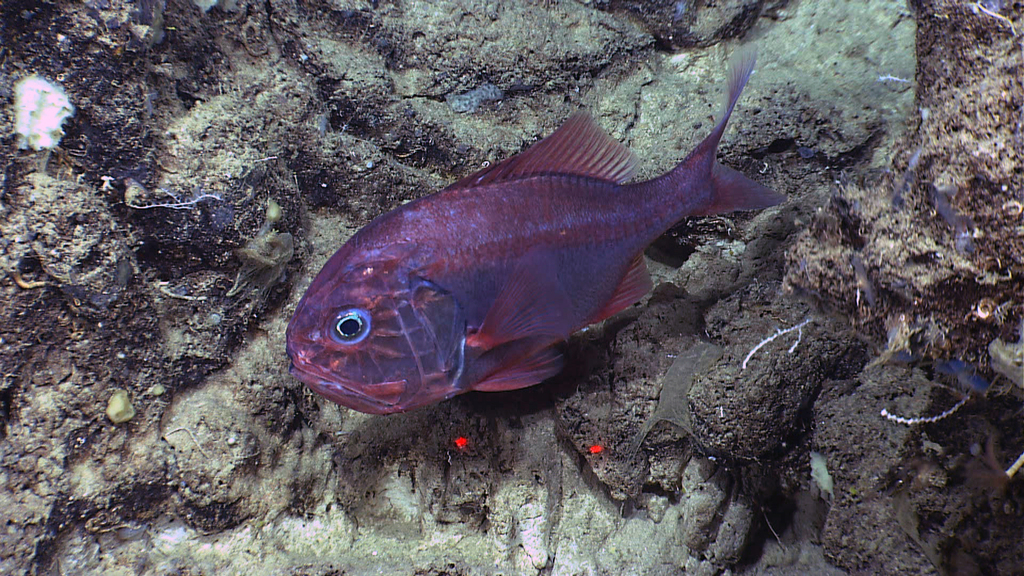 Deep sea perch
Hoplostethus atlanticus
- Rough-fish
Hoplostethus mediterraneus
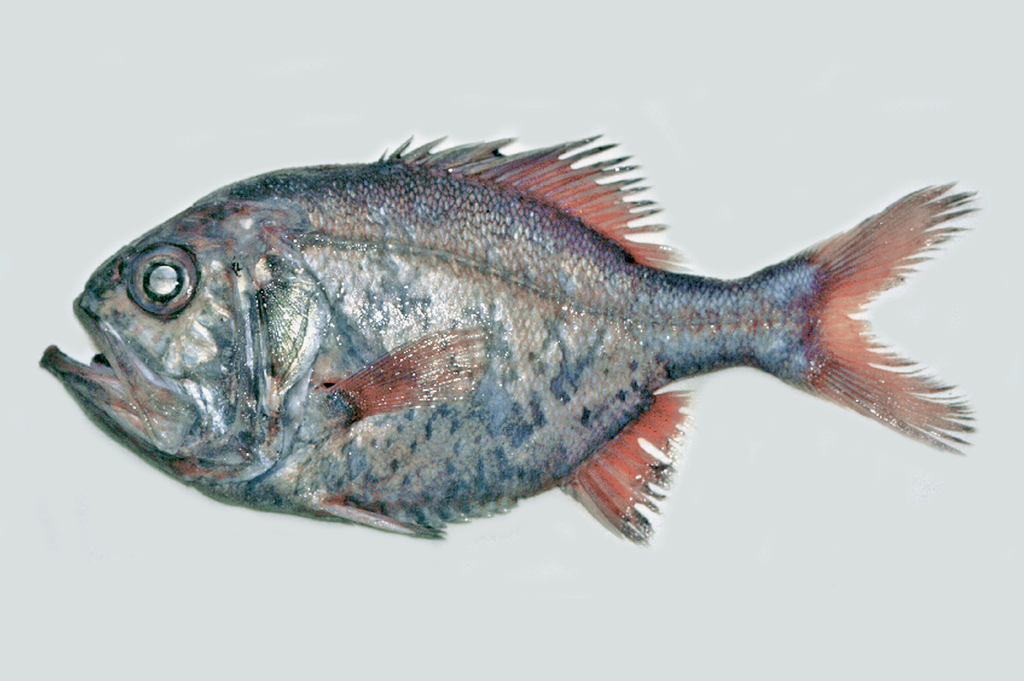 Giant Saw-belly
Hoplostethus gigas
- Thickspine roughy
Hoplostethus crassispinus
- Western Pacific Roughy
Hoplostethus japonicus
- Mediterranean Saw-belly
Hoplostethus latus
Sources and credits
Names and taxonomy: WoRMS (CC BY 4.0) and the GBIF Backbone (CC BY 4.0). Photos: iNaturalist observers, each under the licence shown (CC0, CC BY or CC BY-SA).
- Depth, temperature, months and maps: records from OBIS and GBIF under CC0 or CC BY.
- Descriptions: Wikipedia, licensed CC BY-SA, each linked to its article.
- Conservation status as published by GBIF (IUCN Red List).
- 21 open-data records from 1976 to 2001.
- Species data updated November 3, 2026.
Log what you see on your next dive
The free DiveHive diver app keeps your logbook with every sighting and shows what lives at the site you dive next.