
Glassy Sprat
Hyperlophus translucidus
- Usual depth6 m
- Water temperature19–23 °C
- Best monthsMay, September, and October
- How commonRare
About this species
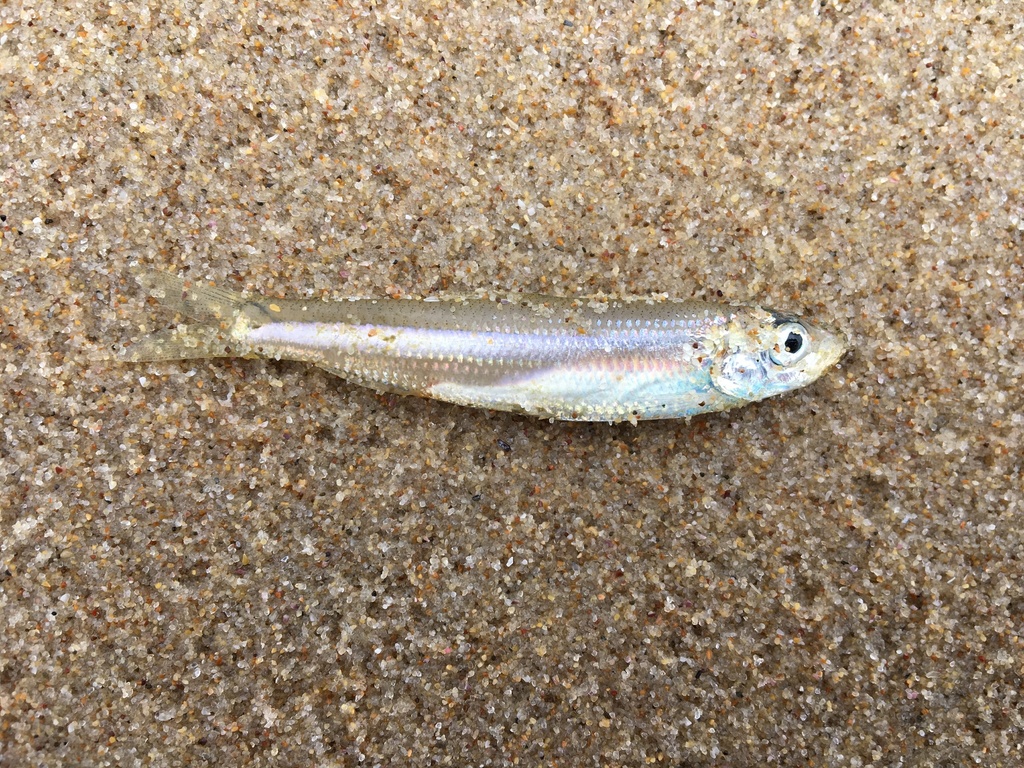
The glassy sprat is a type of sprat fish. The fish, when alive, is translucent, so it gets the second word in its scientific name from the Latin word translucidus, meaning transparent, diaphanous. In animal classification the glassy sprat belongs to Osteichthyes, Clupeiformes, Clupeidae, Hyperlophus. The glassy sprat is native to Australia and mainly found in Australia. It is marked as NE because it has not yet been evaluated by the World Animal Protection. It is mainly used as an economical aquatic product. In ecosystems, they are at the bottom end of the food chain, feeding mainly on plankton, which are less aggressive and very vulnerable to other fish. Glassy sprat are tiny in size and translucent with a silvery streak that extends from its tail to just behind its head. As early as a hundred years ago, Australians harvested the glassy sprat in large quantities and it featured on the table as food for a long time. Due to its poor appearance, it is not a very good ornamental fish.
Text from the Wikipedia article “Glassy sprat”, licensed CC BY-SA 4.0. Read the article
Where and when
Where it has been recorded
Worldwide
Loading the map
Best months
Worldwide (open data)
- January: 2 records
- February: 1 records
- March: 6 records
- April: 1 records
- May: 10 records
- June: 5 records
- July: 5 records
- August: 0 records
- September: 10 records
- October: 11 records
- November: 5 records
- December: 5 records
Depth and water temperature
Depth
Mostly recorded at 6 m · Deepest record: 6 m
Water temperature
Recorded in surface water of 19–23 °C
Names and classification
- English
- Glassy Sprat, grassy sprat, transparent sandy sprat
Similar species
 Glassy
Hyperlophus vittatus
Sources and credits
Names and taxonomy: WoRMS (CC BY 4.0) and the GBIF Backbone (CC BY 4.0). Photos: iNaturalist observers, each under the licence shown (CC0, CC BY or CC BY-SA).
- Depth, temperature, months and maps: records from OBIS and GBIF under CC0 or CC BY.
- Descriptions: Wikipedia, licensed CC BY-SA, each linked to its article.
- Conservation status as published by GBIF (IUCN Red List).
- 93 open-data records from 1903 to 2010.
- Species data updated November 3, 2026.
Log what you see on your next dive
The free DiveHive diver app keeps your logbook with every sighting and shows what lives at the site you dive next.