
Hypothalassia acerba
- Usual depth196–210 m
- Water temperature18–22 °C
- Best monthsNovember
- How commonRare
About this species
Hypothalassia acerba is a large crab found in the muddy substrates of the deep seas off the southwestern Australian and New Zealand coasts. Australian distribution, which is correlated to depth and temperature, ranges from a latitude as far north as approximately 27° S on the west coast, southwards, then eastwards on the south coast to a longitude of at least 129° E. The species usually occurs in waters with temperatures of 13–19 °C (55–66 °F) and in depths ranging of 200–255 metres (656–837 ft) on the lower west coast and 90–200 m (300–660 ft) on the south coast. Body size is inversely related to depth of water. There are only two species in the genus Hypothalassia, and H. acerba is not the same champagne crab as the other Hypothalassia species, H. armata, which is found in Japanese waters.
Text from the Wikipedia article “Hypothalassia acerba”, licensed CC BY-SA 4.0. Read the article
Where and when
Where it has been recorded
Worldwide
Loading the map
Best months
Worldwide (open data)
- January: 0 records
- February: 0 records
- March: 0 records
- April: 0 records
- May: 0 records
- June: 0 records
- July: 0 records
- August: 0 records
- September: 0 records
- October: 0 records
- November: 4 records
- December: 0 records
Depth and water temperature
Depth
Mostly recorded at 196–210 m · Deepest record: 210.3 m
Water temperature
Recorded in surface water of 18–22 °C
Names and classification
Similar species
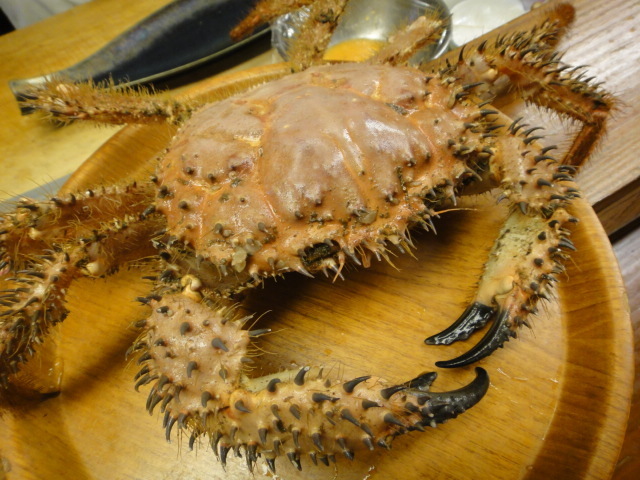 champagne crab
Hypothalassia armata
Sources and credits
Names and taxonomy: WoRMS (CC BY 4.0) and the GBIF Backbone (CC BY 4.0). Photos: iNaturalist observers, each under the licence shown (CC0, CC BY or CC BY-SA).
- Depth, temperature, months and maps: records from OBIS and GBIF under CC0 or CC BY.
- Descriptions: Wikipedia, licensed CC BY-SA, each linked to its article.
- Conservation status as published by GBIF (IUCN Red List).
- 16 open-data records from 2005 to 2005.
- Species data updated November 3, 2026.
Log what you see on your next dive
The free DiveHive diver app keeps your logbook with every sighting and shows what lives at the site you dive next.