
DiscoverSpeciesSharks and rays
Bigeye houndshark
Iago omanensis
- Usual depth105–500 m
- Water temperature24–29 °C
- Best monthsJuly, August, and September
- How commonRare
About this species
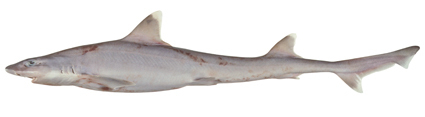
The bigeye houndshark is a species of houndshark, belonging to the family Triakidae. It is a small, placental viviparous shark that is found abundantly in the deep waters of the Gulf of Aqaba, Red Sea. It is described as brown or grey dorsally, with a lighter underside with darker tips on its dorsal and caudal fins. It is found in the deep waters of the continental shelves in the western Indian Ocean, from the Red Sea to southwestern India, between latitudes 30° N and 10° N, at depths between 110 and 2,200 m. Its length can vary between males and females, males can be up to 37 cm (15 in), whilst females have been found as large as 58 cm (23 in). Its diet mainly consists of bony fish and squid/cuttlefish
Text from the Wikipedia article “Bigeye houndshark”, licensed CC BY-SA 4.0. Read the article
Where and when
Where it has been recorded
Worldwide
Loading the map
Best months
Worldwide (open data)
- January: 6 records
- February: 9 records
- March: 6 records
- April: 3 records
- May: 1 records
- June: 2 records
- July: 19 records
- August: 23 records
- September: 20 records
- October: 11 records
- November: 9 records
- December: 5 records
Depth and water temperature
Depth
Mostly recorded at 105–500 m · Deepest record: 500 m
Water temperature
Recorded in surface water of 24–29 °C
Names and classification
- English
- Bigeye houndshark, bigeye houndshark
Names in 2 more languages
- German
- Großaugen-Hundshai
- Thai
- ปลาฉลามหมาตาโต
Other scientific names: Eugaleus omanensis, Galeorhinus omanensis, Jago omanensis
Similar species
- Longnose houndshark
Iago garricki
 Sweet william
Galeorhinus galeus
 Sicklefin Hound Shark
Hemitriakis falcata
 Japanese topeshark
Hemitriakis japanica
- Mack's Whiskery Shark
Furgaleus macki
Sources and credits
Names and taxonomy: WoRMS (CC BY 4.0) and the GBIF Backbone (CC BY 4.0). Photos: iNaturalist observers, each under the licence shown (CC0, CC BY or CC BY-SA).
- Depth, temperature, months and maps: records from OBIS and GBIF under CC0 or CC BY.
- Descriptions: Wikipedia, licensed CC BY-SA, each linked to its article.
- Conservation status as published by GBIF (IUCN Red List).
- 24 open-data records from 1939 to 2018.
- Species data updated November 3, 2026.
Log what you see on your next dive
The free DiveHive diver app keeps your logbook with every sighting and shows what lives at the site you dive next.