
DiscoverSpeciesSharks and rays
Velvet Skate
Insentiraja subtilispinosa
- Usual depth614–1,120 m
- Water temperature22–29 °C
- Best monthsFebruary
- How commonRare
About this species
Insentiraja subtilispinosa, commonly known as the western looseskin skate or velvet skate, is a common deep water skate in the family Arhynchobatidae. Based on reported bycatch rates and population observances, there is no evidence to support concern of the western looseskin skate.
Text from the Wikipedia article “Insentiraja subtilispinosa”, licensed CC BY-SA 4.0. Read the article
Where and when
Where it has been recorded
Worldwide
Loading the map
Best months
Worldwide (open data)
- January: 7 records
- February: 12 records
- March: 0 records
- April: 0 records
- May: 1 records
- June: 1 records
- July: 0 records
- August: 0 records
- September: 1 records
- October: 0 records
- November: 1 records
- December: 1 records
Depth and water temperature
Depth
Mostly recorded at 614–1,120 m · Deepest record: 1,580 m
Water temperature
Recorded in surface water of 22–29 °C
Names and classification
- English
- Velvet Skate, Western Looseskin Skate
Other scientific names: Notoraja subtilispinosa
Similar species
- Eastern Looseskin Skate
Insentiraja laxipella
- Longnose Deep-sea Skate
Bathyraja shuntovi
- Prickly Deepsea Skate
Brochiraja asperula
- Prickly deep-sea skate
Brochiraja spinifera
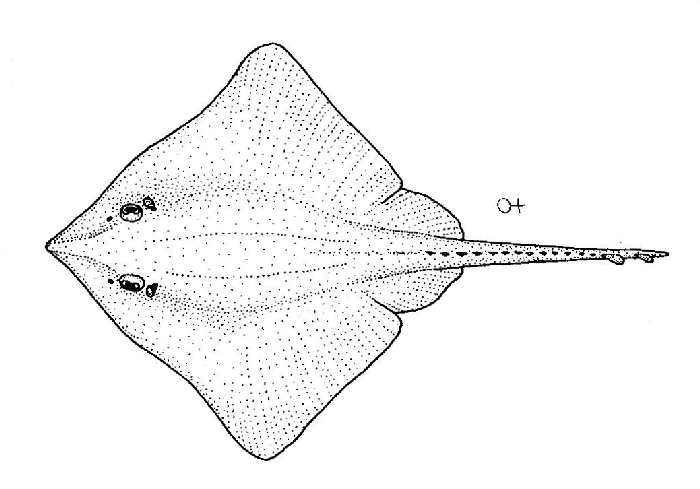 Deepwater skate
Bathyraja richardsoni
- Longtailed Skate
Arhynchobatis asperrimus
Sources and credits
Names and taxonomy: WoRMS (CC BY 4.0) and the GBIF Backbone (CC BY 4.0). Photos: iNaturalist observers, each under the licence shown (CC0, CC BY or CC BY-SA).
- Depth, temperature, months and maps: records from OBIS and GBIF under CC0 or CC BY.
- Descriptions: Wikipedia, licensed CC BY-SA, each linked to its article.
- Conservation status as published by GBIF (IUCN Red List).
- 84 open-data records from 1980 to 2007.
- Species data updated November 3, 2026.
Log what you see on your next dive
The free DiveHive diver app keeps your logbook with every sighting and shows what lives at the site you dive next.