
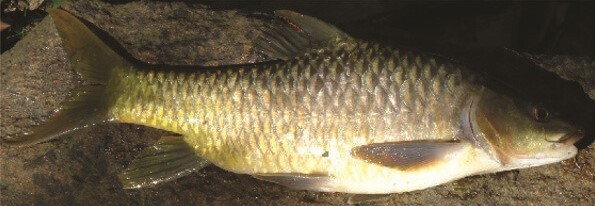
Photo credit: (c) Simagegnew Melaku, Abebe Getahun, Mulugeta Wakjira, some rights reserved (CC BY) · CC BY · iNaturalist
About this species
Labeobarbus intermedius is an East African ray-finned fish species in the family Cyprinidae. Like the closely related yellowfish, it is hexaploid. A large species, the maximum recorded standard length is nearly 50 cm (20 in). This species has a subspecies named Labeobarbus intermedius intermedius.
Text from the Wikipedia article “Labeobarbus intermedius”, licensed CC BY-SA 4.0. Read the article
Where and when
Where it has been recorded
Worldwide
Loading the map
Best months
Worldwide (open data)
- January: 1 records
- February: 1 records
- March: 2 records
- April: 0 records
- May: 0 records
- June: 1 records
- July: 1 records
- August: 0 records
- September: 0 records
- October: 2 records
- November: 1 records
- December: 0 records
Depth and water temperature
Depth
Mostly recorded at 3–7 m · Deepest record: 6.5 m
Names and classification
Other scientific names: Barbus affinis, Barbus alticola, Barbus bingeri, Barbus bottegi, Barbus brevibarbis, Barbus brunellii, Barbus duchesnii, Barbus elongatus, Barbus erlangeri, Barbus eumystus, Barbus gregorii, Barbus gudaricus, Barbus harringtonii, Barbus hursensis, Barbus ilgi, Barbus intermedius, Barbus jarsinus, Barbus kassamensis, Barbus leptosoma, Barbus macmillani, Barbus macronema, Barbus margaritae, Barbus mento, Barbus neuvillei, Barbus neuvillii, Barbus oreas, Barbus plagiostomus, Barbus platystomus, Barbus procatopus, Barbus rueppellii
Sources and credits
Names and taxonomy: WoRMS (CC BY 4.0) and the GBIF Backbone (CC BY 4.0). Photos: iNaturalist observers, each under the licence shown (CC0, CC BY or CC BY-SA).
- Depth, temperature, months and maps: records from OBIS and GBIF under CC0 or CC BY.
- Descriptions: Wikipedia, licensed CC BY-SA, each linked to its article.
- Conservation status as published by GBIF (IUCN Red List).
- 768 open-data records from 1993 to 1997.
- Species data updated November 3, 2026.
Log what you see on your next dive
The free DiveHive diver app keeps your logbook with every sighting and shows what lives at the site you dive next.