
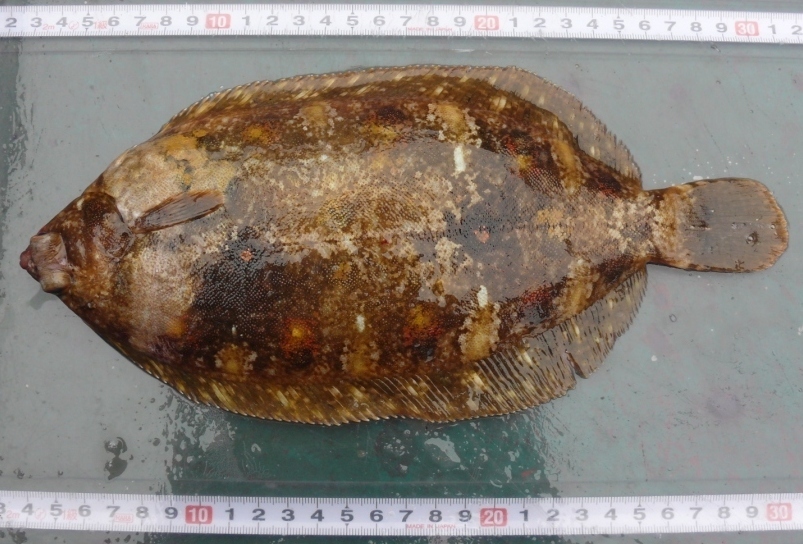
Slime flounder
Microstomus achne
- Usual depth67–343 m
- Water temperature4–22 °C
- Best monthsJune
- How commonRare
Photo credit: (c) Баранчук-Червонный Лев, some rights reserved (CC BY-SA) · CC BY-SA · iNaturalist
About this species
The slime flounder is a kind of flatfish from the family Pleuronectidae. It is a demersal fish that lives on sand and mud bottoms at depths of between 15 and 800 metres, though it is most commonly found between 20 and 610 metres. Its native habitat is the temperate waters of the northwest Pacific, from the East China Sea to the Yellow Sea and the Sea of Japan, as far as Sakhalin and the Kuril Islands. It reaches up to 60 centimetres (24 in) in length, and can weigh up to 1.76 kilograms (3.9 lb).
Text from the Wikipedia article “Slime flounder”, licensed CC BY-SA 4.0. Read the article
Where and when
Where it has been recorded
Worldwide
Loading the map
Best months
Worldwide (open data)
- January: 0 records
- February: 0 records
- March: 0 records
- April: 2 records
- May: 0 records
- June: 4 records
- July: 0 records
- August: 0 records
- September: 1 records
- October: 2 records
- November: 2 records
- December: 1 records
Depth and water temperature
Depth
Mostly recorded at 67–343 m · Deepest record: 342.5 m
Water temperature
Recorded in surface water of 4–22 °C
Names and classification
- English
- Slime flounder, babagarei
Names in 3 more languages
- Japanese
- Baba-garei, Babagarei, ババガレイ
- Korean
- 찰가자미
- Simplified Chinese
- 亞洲油鰈
Other scientific names: Veraequa achne
Similar species
- Kamchatka flounder
Atheresthes evermanni
- Korean flounder
Glyptocephalus stelleri
 Roughscale sole
Clidoderma asperrimum
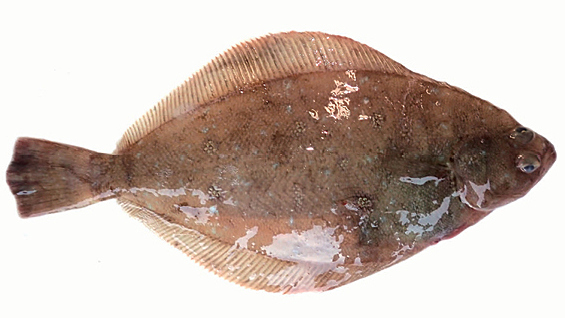 Shotted halibut
Eopsetta grigorjewi
- Pointhead flounder
Cleisthenes pinetorum
- migigarei
Dexistes rikuzenius
Sources and credits
Names and taxonomy: WoRMS (CC BY 4.0) and the GBIF Backbone (CC BY 4.0). Photos: iNaturalist observers, each under the licence shown (CC0, CC BY or CC BY-SA).
- Depth, temperature, months and maps: records from OBIS and GBIF under CC0 or CC BY.
- Descriptions: Wikipedia, licensed CC BY-SA, each linked to its article.
- Conservation status as published by GBIF (IUCN Red List).
- 88 open-data records from 1906 to 2012.
- Species data updated November 4, 2026.
Log what you see on your next dive
The free DiveHive diver app keeps your logbook with every sighting and shows what lives at the site you dive next.