
Glassfish
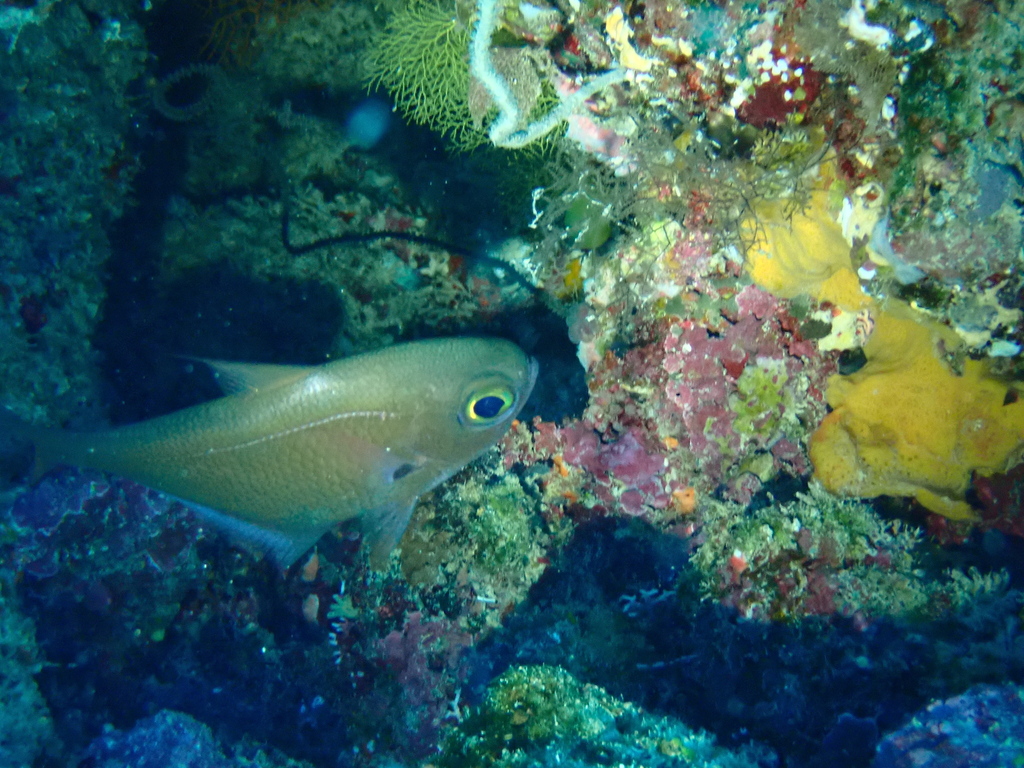
Parapriacanthus ransonneti
- Usual depth10–72 m
- Water temperature20–29 °C
- Best monthsSeptember and October
- How commonOccasional
About this species
Parapriacanthus is a genus of sweepers native to the Indian Ocean and the western Pacific Ocean. Parapriacanthus are bioluminescent, with ventral light organs for counter-illumination. Parapriacanthus luciferase is a kleptoprotein, obtained from their diet on bioluminescent ostracods.
Text from the Wikipedia article “Parapriacanthus”, licensed CC BY-SA 4.0. Read the article
Where and when
Where it has been recorded
Worldwide
Loading the map
Best months
Worldwide (open data)
- January: 7 records
- February: 5 records
- March: 5 records
- April: 9 records
- May: 15 records
- June: 10 records
- July: 5 records
- August: 8 records
- September: 26 records
- October: 20 records
- November: 11 records
- December: 14 records
Depth and water temperature
Depth
Mostly recorded at 10–72 m · Deepest record: 300 m
Water temperature
Recorded in surface water of 20–29 °C
Names and classification
- English
- Glassfish, Golden Bullseye, Golden Sweeper, Pygmy Sweeper, Ransonnet's Bullseye, Rosy Sweep, Yellow Sweeper
Names in 4 more languages
- German
- Glasfisch, Indischer Glasfisch
- French
- Poisson de verre, Poisson hachette nain, Poisson-hachette nain
- Japanese
- Kimmemodoki, キンメモドキ
- Simplified Chinese
- 大面側仔, 紅海副單鰭魚, 雷氏充金眼鯛, 雷氏充金眼鯛(紅海副單鰭魚)
Other scientific names: Parapriacanthus beryciformis, Parapriacanthus ransonnari, Parapriacanthus unwini, Pempheris unwini
Similar species
- Guenther's Sweeper
Parapriacanthus guentheri
 Silver sweeper
Pempheris oualensis
- swanky sweeper
Pempheris schwenkii
- Vanikoro sweeper
Pempheris vanicolensis
Sources and credits
Names and taxonomy: WoRMS (CC BY 4.0) and the GBIF Backbone (CC BY 4.0). Photos: iNaturalist observers, each under the licence shown (CC0, CC BY or CC BY-SA).
- Depth, temperature, months and maps: records from OBIS and GBIF under CC0 or CC BY.
- Descriptions: Wikipedia, licensed CC BY-SA, each linked to its article.
- Conservation status as published by GBIF (IUCN Red List).
- 768 open-data records from 1870 to 2022.
Log what you see on your next dive
The free DiveHive diver app keeps your logbook with every sighting and shows what lives at the site you dive next.