
Dark-fin Chromis
Pycnochromis atripes
- Usual depth5–26 m
- Water temperature22–30 °C
- Best monthsJune
- How commonOccasional
About this species
Pycnochromis atripes, the dark-fin chromis, is a diurnal species of damselfish belonging to the genus Pycnochromis. It can be found in the Western Pacific Ocean in Christmas Islands and in north-western Australia in the East Indian Ocean to Kiribati, and north to Southern Japan. It can also be found in Tonga. It inhabits areas of outer reef and slopes which are rich in coral, appearing singly or in small groups near the bottom. It is oviparous, and the males of the species guard and aerate the eggs.
Text from the Wikipedia article “Pycnochromis atripes”, licensed CC BY-SA 4.0. Read the article
Where and when
Where it has been recorded
Worldwide
Loading the map
Best months
Worldwide (open data)
- January: 54 records
- February: 24 records
- March: 22 records
- April: 13 records
- May: 58 records
- June: 129 records
- July: 41 records
- August: 38 records
- September: 67 records
- October: 44 records
- November: 41 records
- December: 8 records
Depth and water temperature
Depth
Mostly recorded at 5–26 m · Deepest record: 534 m
Water temperature
Recorded in surface water of 22–30 °C
Names and classification
- English
- Dark-fin Chromis, Darkfin Chromis, Darkfin Puller, Dusky Puller
Names in 3 more languages
- French
- Chromis à nageoires sombres
- Japanese
- Hiregurosuzumedai, ヒレグロスズメダイ
- Simplified Chinese
- 黑鰭光鰓雀鯛
Other scientific names: Chromis atripes
Similar species
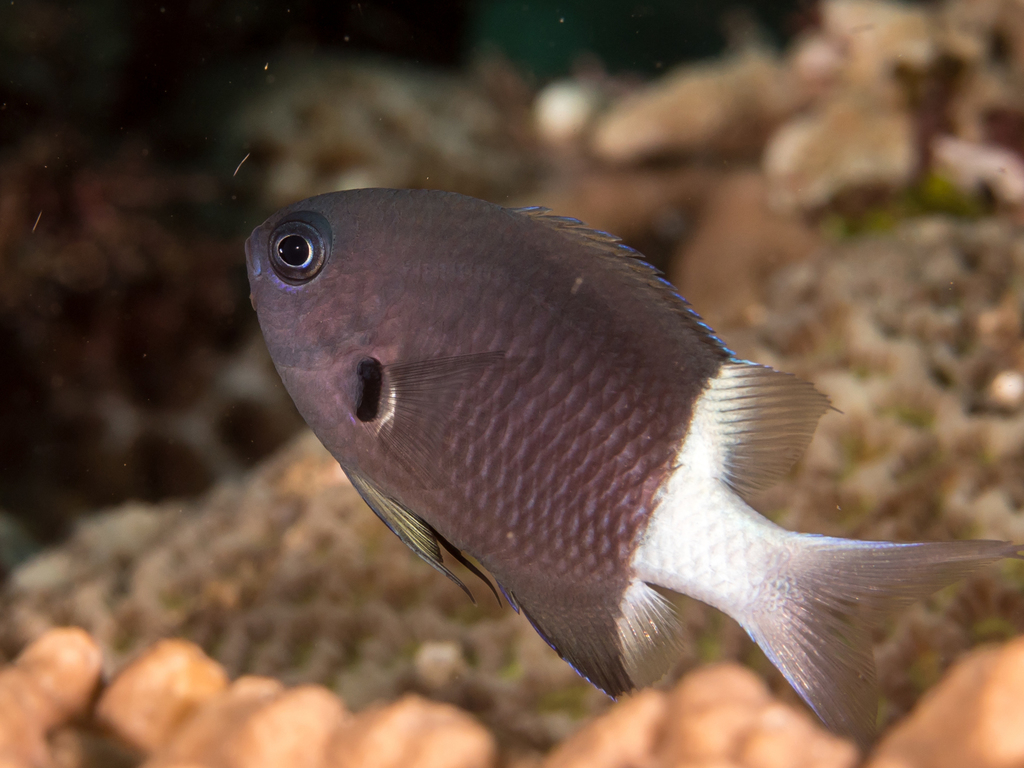 Bicolor Chromis
Pycnochromis margaritifer
- Agile Chromis
Pycnochromis agilis
- Blackfin Chromis
Pycnochromis vanderbilti
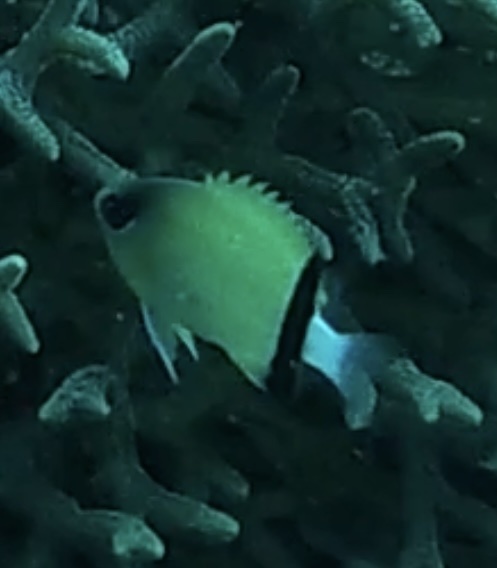 Black-bar Chromis
Pycnochromis retrofasciatus
- Ambon Chromis
Pycnochromis amboinensis
- Bicolor Damselfish
Pycnochromis dimidiatus
Sources and credits
Names and taxonomy: WoRMS (CC BY 4.0) and the GBIF Backbone (CC BY 4.0). Photos: iNaturalist observers, each under the licence shown (CC0, CC BY or CC BY-SA).
- Depth, temperature, months and maps: records from OBIS and GBIF under CC0 or CC BY.
- Descriptions: Wikipedia, licensed CC BY-SA, each linked to its article.
- Conservation status as published by GBIF (IUCN Red List).
- 561 open-data records from 1908 to 2023.
Log what you see on your next dive
The free DiveHive diver app keeps your logbook with every sighting and shows what lives at the site you dive next.