
Bicolor Damselfish
Pycnochromis dimidiatus
- Usual depth1–27 m
- Water temperature19–30 °C
- Best monthsApril, May, and August
- How commonOccasional
About this species
Pycnochromis dimidiatus, commonly known as the chocolatedip chromis or Red Sea half-and-half chromis, is a species of chromine damselfish in the genus Pycnochromis. It is endemic to the Red Sea, where individuals prefer to live on reefs from depths of 1–36 m (3.3–118.1 ft). It was described by Carl Benjamin Klunzinger in 1871. It resembles several other species of the genus Pycnochromis, such as P. iomelas, P. fieldi, P. hanui, P. margaritifer, and P. bami.
Text from the Wikipedia article “Pycnochromis dimidiatus”, licensed CC BY-SA 4.0. Read the article
Where and when
Where it has been recorded
Worldwide
Loading the map
Best months
Worldwide (open data)
- January: 4 records
- February: 11 records
- March: 10 records
- April: 39 records
- May: 27 records
- June: 18 records
- July: 18 records
- August: 28 records
- September: 22 records
- October: 27 records
- November: 24 records
- December: 8 records
Depth and water temperature
Depth
Mostly recorded at 1–27 m · Deepest record: 80 m
Water temperature
Recorded in surface water of 19–30 °C
Names and classification
- English
- Bicolor Damselfish, chocolatedip chromis, half-and-half chromis, Red Sea Half-and-half Chromis
Names in 3 more languages
- German
- Zweifarben-Riffbarsch
- French
- Chromis bicolore de Mer Rouge
- Thai
- ปลาสลิดหินตาโต
Other scientific names: Chromis dimidata, Chromis dimidiata, Chromis dimidiate, Chromis dimidiatus, Heliastes dimidiatus
Similar species
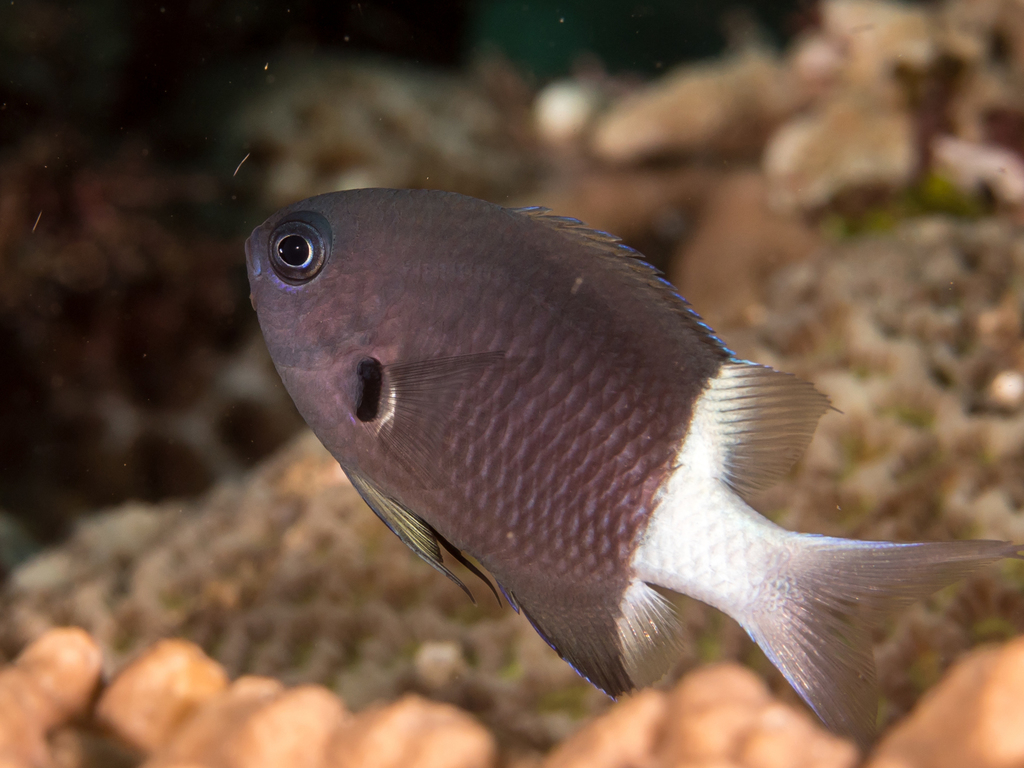 Bicolor Chromis
Pycnochromis margaritifer
- Agile Chromis
Pycnochromis agilis
- Blackfin Chromis
Pycnochromis vanderbilti
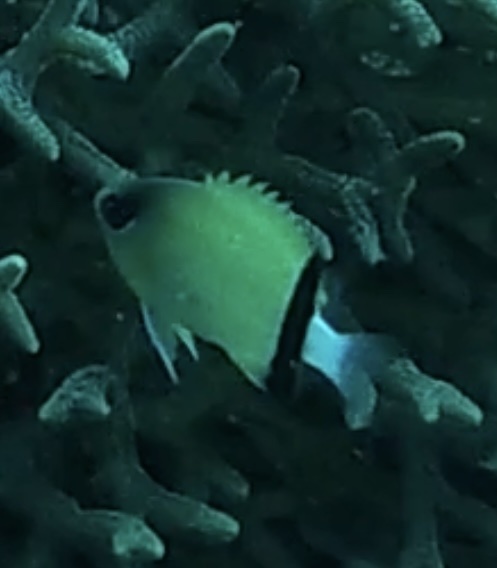 Black-bar Chromis
Pycnochromis retrofasciatus
- Ambon Chromis
Pycnochromis amboinensis
- Dark-fin Chromis
Pycnochromis atripes
Sources and credits
Names and taxonomy: WoRMS (CC BY 4.0) and the GBIF Backbone (CC BY 4.0). Photos: iNaturalist observers, each under the licence shown (CC0, CC BY or CC BY-SA).
- Depth, temperature, months and maps: records from OBIS and GBIF under CC0 or CC BY.
- Descriptions: Wikipedia, licensed CC BY-SA, each linked to its article.
- Conservation status as published by GBIF (IUCN Red List).
- 261 open-data records from 1871 to 2021.
Log what you see on your next dive
The free DiveHive diver app keeps your logbook with every sighting and shows what lives at the site you dive next.