
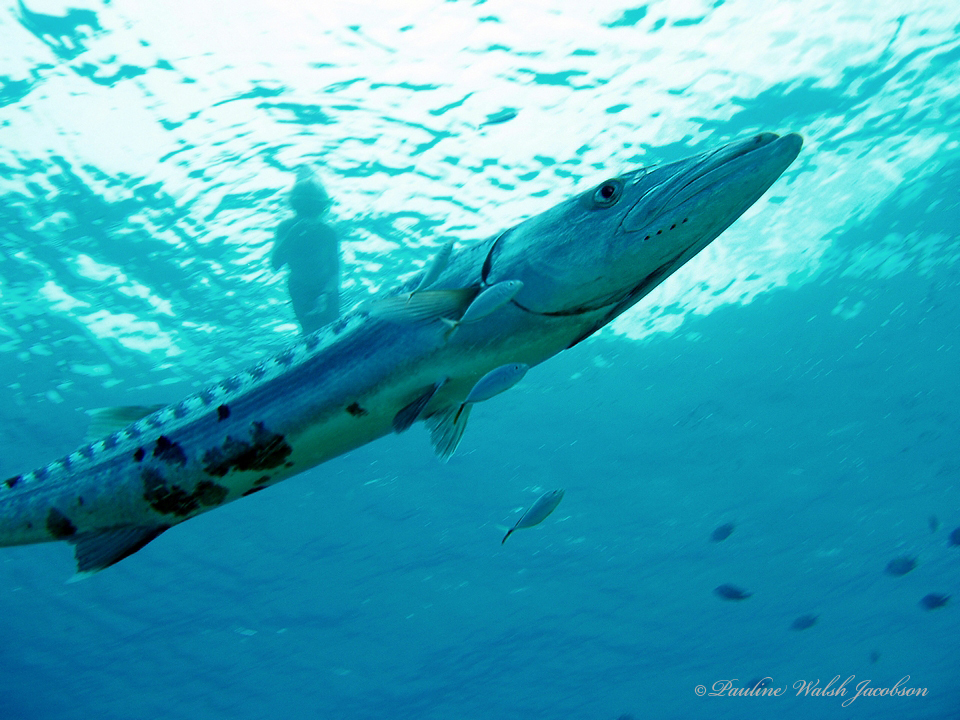
Bigeye barracuda
Sphyraena forsteri
- Usual depth24–102 m
- Water temperature24–30 °C
- Best monthsOctober
- How commonOccasional
About this species
The bigeye barracuda is a species of the family Sphyraenidae, which can be found in the tropical Indo-West Pacific oceans, excluding Hawaii.
Text from the Wikipedia article “Bigeye barracuda”, licensed CC BY-SA 4.0. Read the article
Where and when
Where it has been recorded
Worldwide
Loading the map
Best months
Worldwide (open data)
- January: 14 records
- February: 14 records
- March: 7 records
- April: 19 records
- May: 12 records
- June: 25 records
- July: 12 records
- August: 28 records
- September: 27 records
- October: 54 records
- November: 13 records
- December: 16 records
Depth and water temperature
Depth
Mostly recorded at 24–102 m · Deepest record: 135 m
Water temperature
Recorded in surface water of 24–30 °C
Names and classification
- English
- Bigeye barracuda, bigeye barracuda, Big-eye Sea-pyke, Black-spot Barracuda, Blackspot Barracuda, Blotched Sea-pike
Names in 7 more languages
- German
- Brustfleck-Barrakuda, Großaugen-Barrakuda
- Spanish
- Baracuda
- Filipino
- Balyos, Batig, Tursilyo
- French
- Bécune de Forster
- Japanese
- Omekamasu, オオメカマス
- Thai
- ปลาน้ำดอกไม้ตาโต
- Simplified Chinese
- 大眼金梭魚, 大眼魣, 巴拉庫答, 竹梭, 針梭
Other scientific names: Callosphyraena toxeuma, Sphyraena forsteni, Sphyraena toxeuma
Similar species
 Great barracuda
Sphyraena barracuda
- Yellowtail barracuda
Sphyraena flavicauda
- Pickhandle barracuda
Sphyraena jello
- Obtuse barracuda
Sphyraena obtusata
- chevron barracuda
Sphyraena putnamae
- Blackfin barracuda
Sphyraena qenie
Sources and credits
Names and taxonomy: WoRMS (CC BY 4.0) and the GBIF Backbone (CC BY 4.0). Photos: iNaturalist observers, each under the licence shown (CC0, CC BY or CC BY-SA).
- Depth, temperature, months and maps: records from OBIS and GBIF under CC0 or CC BY.
- Descriptions: Wikipedia, licensed CC BY-SA, each linked to its article.
- Conservation status as published by GBIF (IUCN Red List).
- 578 open-data records from 1829 to 2023.
Log what you see on your next dive
The free DiveHive diver app keeps your logbook with every sighting and shows what lives at the site you dive next.