
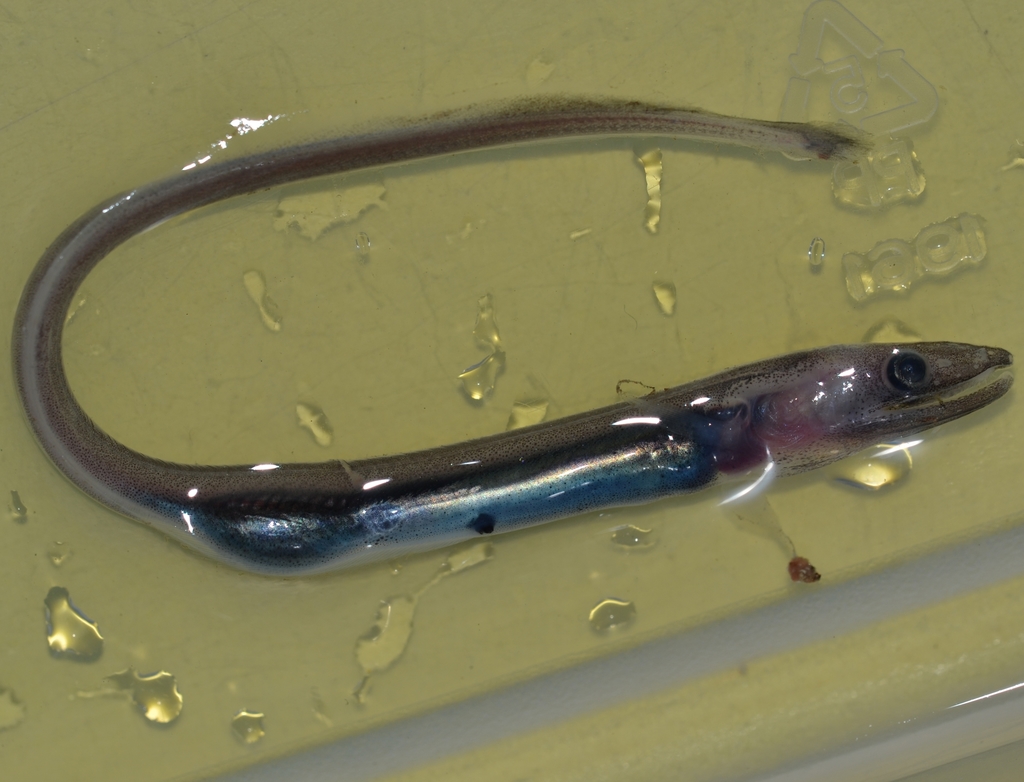
Grey cutthroat eel
Synaphobranchus affinis
- Usual depth520–1,158 m
- Water temperature5–29 °C
- Best monthsApril, May, and December
- How commonOccasional
About this species
The grey cutthroat eel (Synaphobranchus affinis), is a cutthroat eel. It was originally described by Albert Günther in 1877. It lives a benthic lifestyle, inhabiting the continental slope and global deep waters including near Portugal, Canary Islands, Morocco, Japan, Australia, and others. It is a marine, deep water-dwelling eel which has been found at depths ranging from 300 to 2,300 meters and at temperatures ranging from 3.3 - 11.3 °C. Males can grow to a length of up to 110 centimetres. It is primarily a scavenger, however it also actively hunts small fish and crustaceans.
Text from the Wikipedia article “Grey cutthroat eel”, licensed CC BY-SA 4.0. Read the article
Where and when
Where it has been recorded
Worldwide
Loading the map
Best months
Worldwide (open data)
- January: 3 records
- February: 12 records
- March: 17 records
- April: 44 records
- May: 57 records
- June: 36 records
- July: 18 records
- August: 41 records
- September: 29 records
- October: 41 records
- November: 43 records
- December: 51 records
Depth and water temperature
Depth
Mostly recorded at 520–1,158 m · Deepest record: 3,162 m
Water temperature
Recorded in surface water of 5–29 °C
Names and classification
- English
- Grey cutthroat eel, Gilbert's Synaphobranchid Eel, Grey Cutthroat, grey cutthroat eel, Grey Cut-throat Eel, Grey Cutthroat Eel
Names in 2 more languages
- Japanese
- Hora-anago, Horaanago, ホラアナゴ
- Simplified Chinese
- 合鰓鰻, 長鰭合鰓鰻(連鰓鰻)
Other scientific names: Synaphobranchus brachysomus, Synaphobranchus taketae, Synapobranchus affinis
Similar species
 Kaup's arrowtooth eel
Synaphobranchus kaupii
- Shortdorsal Cutthroat Eel
Synaphobranchus brevidorsalis
- Basketwork eel
Diastobranchus capensis
- Parasitic eel
Simenchelys parasitica
- Shortbelly eel
Dysomma anguillare
Sources and credits
Names and taxonomy: WoRMS (CC BY 4.0) and the GBIF Backbone (CC BY 4.0). Photos: iNaturalist observers, each under the licence shown (CC0, CC BY or CC BY-SA).
- Depth, temperature, months and maps: records from OBIS and GBIF under CC0 or CC BY.
- Descriptions: Wikipedia, licensed CC BY-SA, each linked to its article.
- Conservation status as published by GBIF (IUCN Red List).
- 786 open-data records from 1877 to 2024.
- Species data updated October 31, 2026.
Log what you see on your next dive
The free DiveHive diver app keeps your logbook with every sighting and shows what lives at the site you dive next.