
Elongate clam
Tridacna maxima
- Usual depth10–17 m
- Water temperature22–30 °C
- Best monthsSeptember
- How commonCommon
About this species
Tridacna maxima, also known as the maxima clam or the small giant clam, is a species of bivalve mollusc found throughout the Indo-Pacific region.
Text from the Wikipedia article “Maxima clam”, licensed CC BY-SA 4.0. Read the article
Where and when
Where it has been recorded
Worldwide
Loading the map
Best months
Worldwide (open data)
- January: 52 records
- February: 126 records
- March: 125 records
- April: 165 records
- May: 183 records
- June: 311 records
- July: 256 records
- August: 107 records
- September: 889 records
- October: 86 records
- November: 88 records
- December: 98 records
Depth and water temperature
Depth
Mostly recorded at 10–17 m · Deepest record: 38 m
Water temperature
Recorded in surface water of 22–30 °C
Names and classification
- English
- Elongate clam, Elongated clam, Small giant clam, elongate clam, elongated clam, small giant clam
Names in 4 more languages
- German
- Kleine Riesenmuschel, Längliche Riesenmuschel
- French
- Bénitier
- Japanese
- シラナミガイ
- Simplified Chinese
- 長硨磲蛤
Other scientific names: Tridachnes maxima, Tridacna (Chametrachea) maxima, Tridacna acuticostata, Tridacna compressa, Tridacna detruncata, Tridacna elongata, Tridacna fossor, Tridacna imbricata, Tridacna lanceolata, Tridacna mutica, Tridacna reevei, Tridacna rudis
Similar species
- Boring clam
Tridacna crocea
- Giant clam
Tridacna gigas
- Fluted clam
Tridacna squamosa
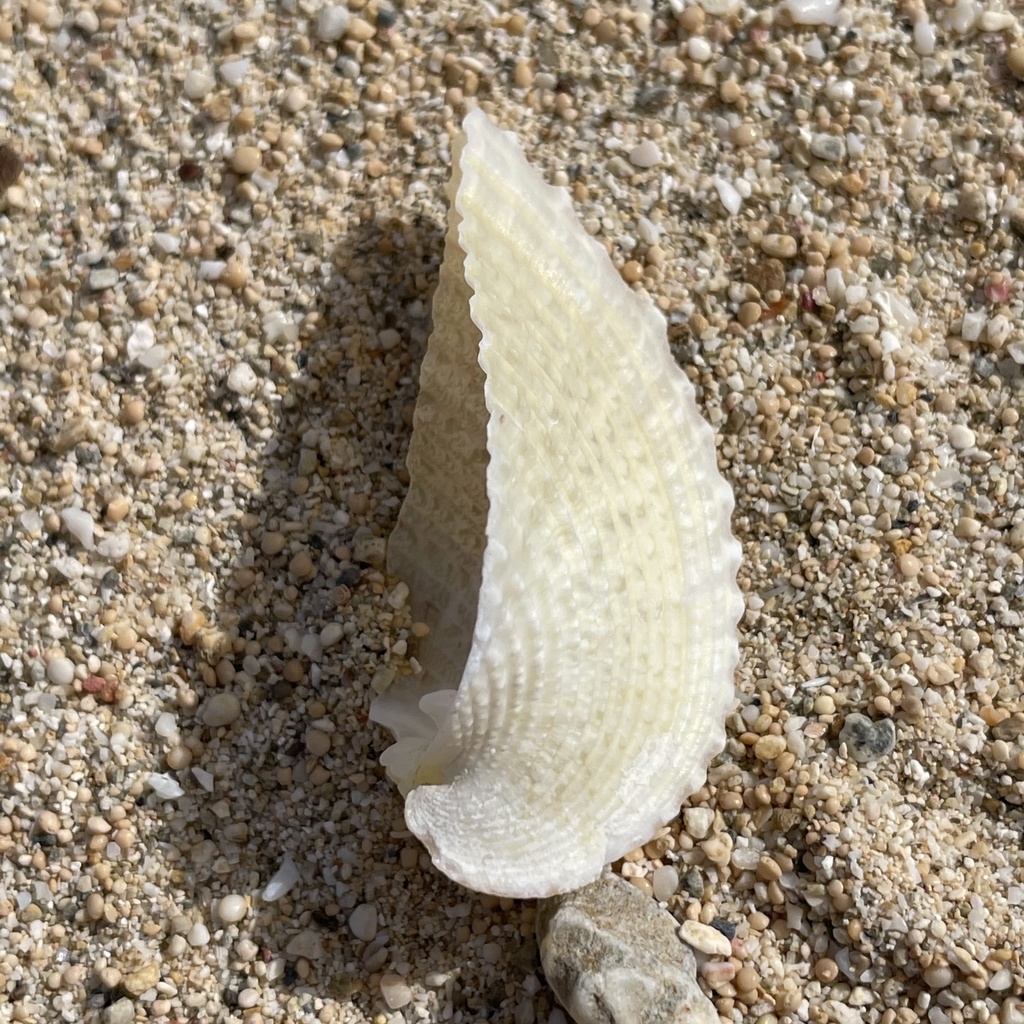 Heart cockle
Corculum cardissa
- Pacific strawberry cockle
Fragum fragum
- Strawberry cockle
Fragum unedo
Sources and credits
Names and taxonomy: WoRMS (CC BY 4.0) and the GBIF Backbone (CC BY 4.0). Photos: iNaturalist observers, each under the licence shown (CC0, CC BY or CC BY-SA).
- Depth, temperature, months and maps: records from OBIS and GBIF under CC0 or CC BY.
- Descriptions: Wikipedia, licensed CC BY-SA, each linked to its article.
- Conservation status as published by GBIF (IUCN Red List).
- 11,037 open-data records from 1798 to 2023.
Log what you see on your next dive
The free DiveHive diver app keeps your logbook with every sighting and shows what lives at the site you dive next.