
Spiny blaasop
Tylerius spinosissimus
- Usual depth88–347 m
- Water temperature20–29 °C
- Best monthsJune, August, and October
- How commonRare
About this species
The spiny blaasop is a species of marine ray-finned fish belonging to the family Tetraodontidae, the pufferfishes. This puffer is native to the Indian Ocean, the southwestern Pacific Ocean and the Atlantic Ocean along the coast of South Africa. It has recently been recorded in the Eastern Mediterranean Sea. This species is the only species in the monospecific genus Tylerius.
Text from the Wikipedia article “Spiny blaasop”, licensed CC BY-SA 4.0. Read the article
Where and when
Where it has been recorded
Worldwide
Loading the map
Best months
Worldwide (open data)
- January: 9 records
- February: 0 records
- March: 6 records
- April: 14 records
- May: 4 records
- June: 18 records
- July: 10 records
- August: 24 records
- September: 7 records
- October: 27 records
- November: 8 records
- December: 5 records
Depth and water temperature
Depth
Mostly recorded at 88–347 m · Deepest record: 425 m
Water temperature
Recorded in surface water of 20–29 °C
Names and classification
- English
- Spiny blaasop, Fine-spined Pufferfish, Finespine Puffer, Finespine Pufferfish, prickle blaasop, spiny blaasop
Names in 3 more languages
- Spanish
- Botete orbe
- Japanese
- Ibarafugu, イバラフグ
- Simplified Chinese
- 氣規, 規仔, 長刺泰氏魨
Other scientific names: Amblyrhinchotes spinosissimus, Amblyrhynchotes spinosissimus, Spheroides spinosissimus, Spheroides unifasciatus
Similar species
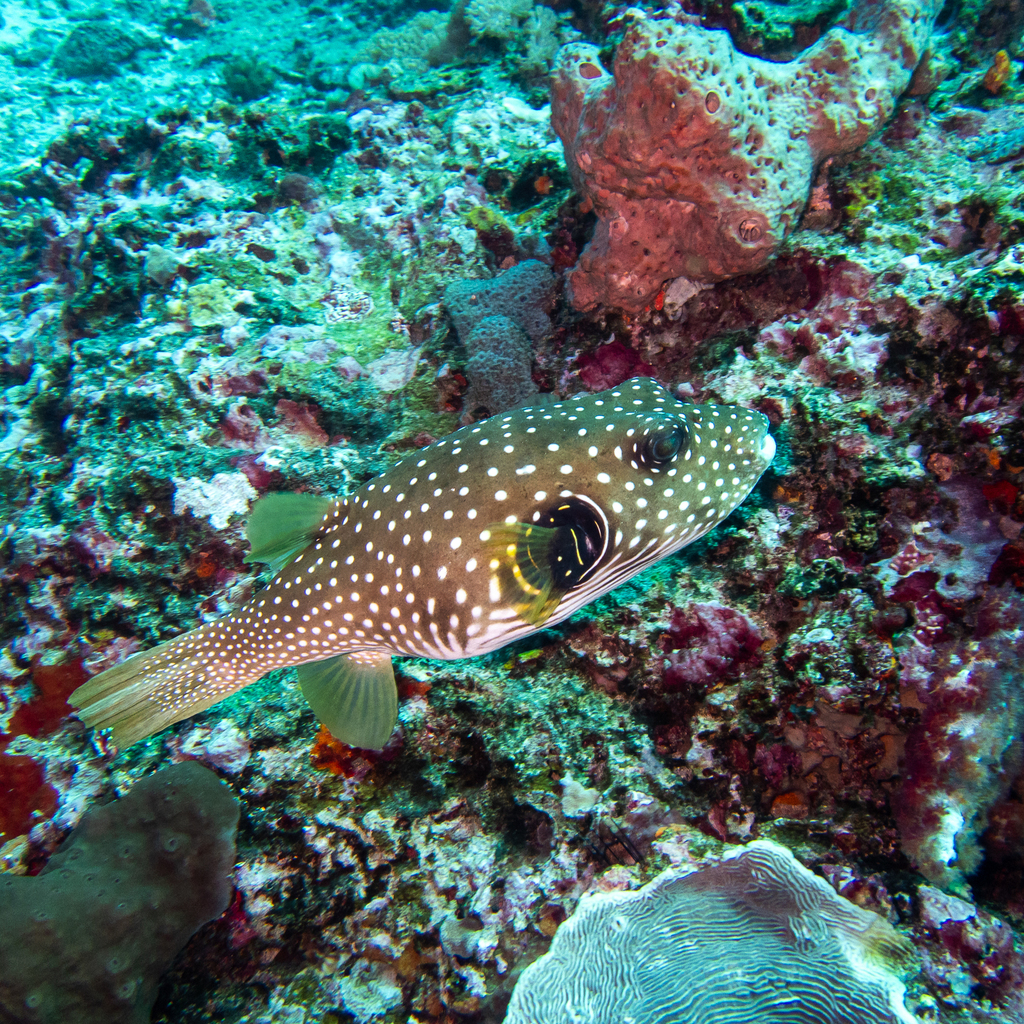 Bristly puffer
Arothron hispidus
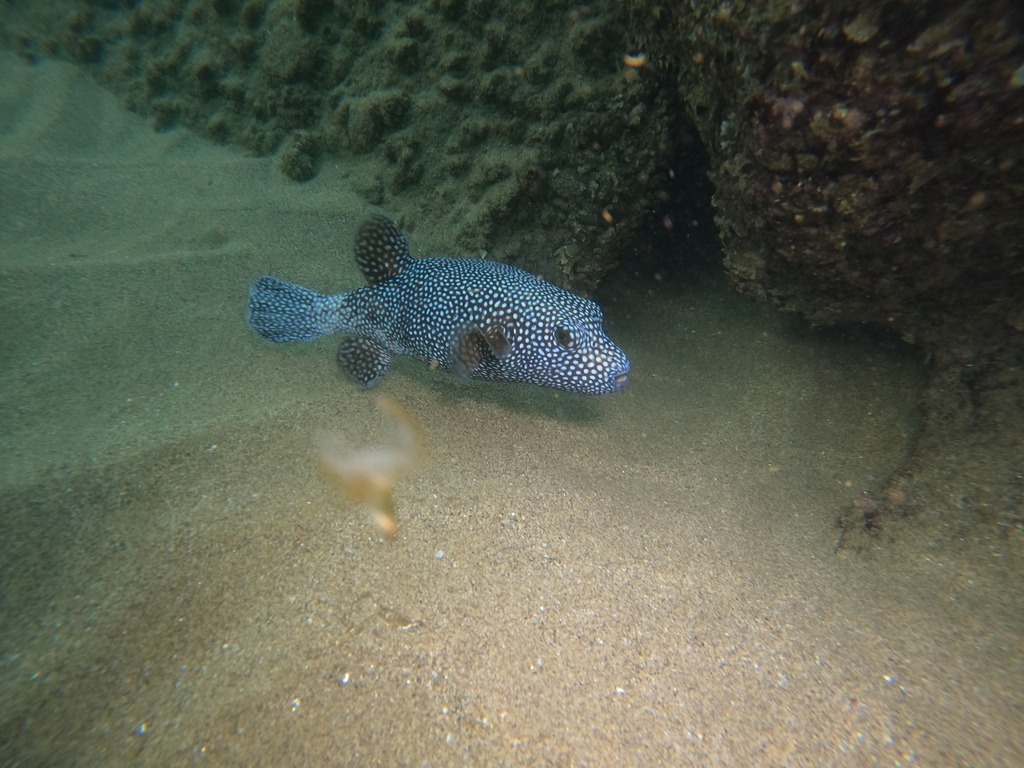 Guineafowl puffer
Arothron meleagris
- Silverstripe blaasop
Lagocephalus sceleratus
 Narrow-lined toadfish
Arothron immaculatus
 Narrow-lined Puffer
Arothron manilensis
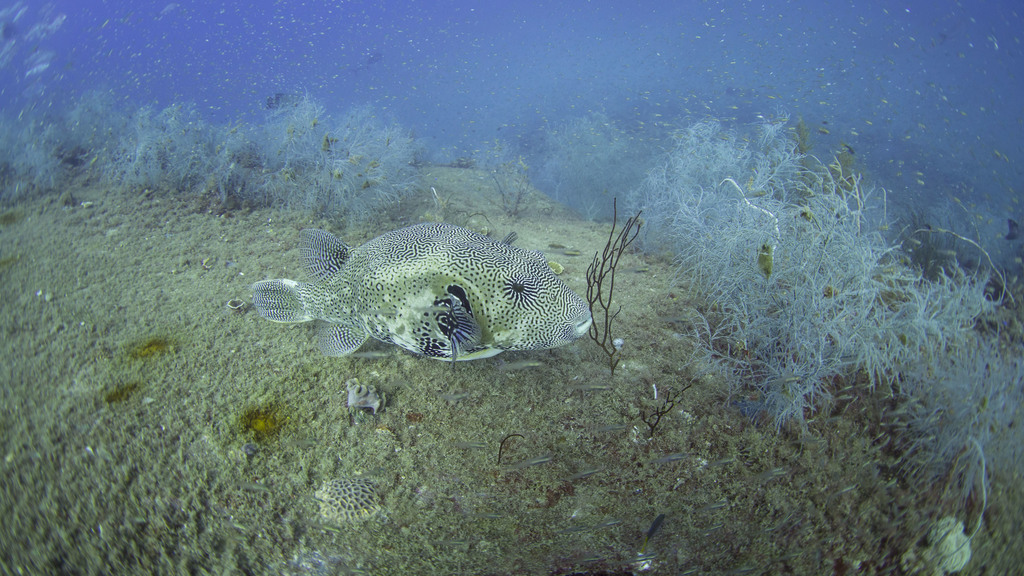 Map puffer
Arothron mappa
Sources and credits
Names and taxonomy: WoRMS (CC BY 4.0) and the GBIF Backbone (CC BY 4.0). Photos: iNaturalist observers, each under the licence shown (CC0, CC BY or CC BY-SA).
- Depth, temperature, months and maps: records from OBIS and GBIF under CC0 or CC BY.
- Descriptions: Wikipedia, licensed CC BY-SA, each linked to its article.
- Conservation status as published by GBIF (IUCN Red List).
- 216 open-data records from 1908 to 2023.
Log what you see on your next dive
The free DiveHive diver app keeps your logbook with every sighting and shows what lives at the site you dive next.