
Delicate Whiptail
Hymenogadus gracilis
- Usual depth255–540 m
- Water temperature17–28 °C
- Best monthsJuly, September, and November
- How commonRare
Photo credit: (c) W Schwarzhans, some rights reserved (CC BY) · CC BY · iNaturalist
About this species
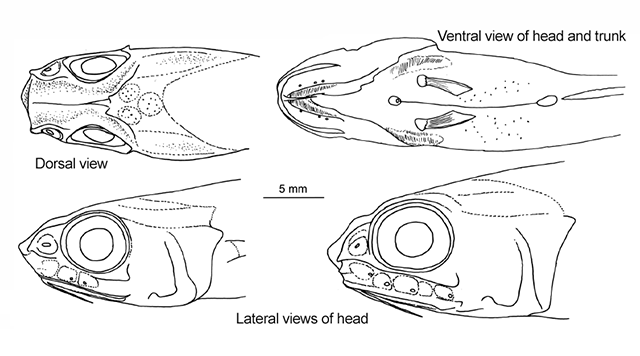
The graceful grenadier is a species of rattail fish. It is found at depths of 160–345 m (525–1,132 ft) in tropical and subtropical seas worldwide. This is one of the smallest of the rattails, growing to no more than 13 cm (5.1 in) in length. It is a slender fish with a large mouth, with rows of very small teeth, positioned in the underside of the skull. There is a short, thin chin barbel. It is more strikingly marked than most rattails, with bold black streaks on the head and black and silver barring over most of the body. There is a long bioluminescent organ with two lenses underneath the rear end of the body.
Text from the Wikipedia article “Graceful grenadier”, licensed CC BY-SA 4.0. Read the article
Where and when
Where it has been recorded
Worldwide
Loading the map
Best months
Worldwide (open data)
- January: 1 records
- February: 3 records
- March: 2 records
- April: 0 records
- May: 2 records
- June: 2 records
- July: 6 records
- August: 4 records
- September: 6 records
- October: 2 records
- November: 5 records
- December: 3 records
Depth and water temperature
Depth
Mostly recorded at 255–540 m · Deepest record: 600 m
Water temperature
Recorded in surface water of 17–28 °C
Names and classification
- English
- Delicate Whiptail, Graceful Grenadier
Names in 1 more languages
- Japanese
- Onisujidara, オニスジダラ
Other scientific names: Hymenocephalus (Hymenogadus) gracilis, Hymenocephalus gracilis
Similar species
- Bollons' rattail
Coelorinchus bollonsi
- Banded Whip-tail
Coelorinchus fasciatus
- Innotable Whiptail
Coelorinchus innotabilis
- Serrulate Rattail
Coryphaenoides serrulatus
- Four-rayed Rattail
Coryphaenoides subserrulatus
- deepsea whiptail
Lepidorhynchus denticulatus
Sources and credits
Names and taxonomy: WoRMS (CC BY 4.0) and the GBIF Backbone (CC BY 4.0). Photos: iNaturalist observers, each under the licence shown (CC0, CC BY or CC BY-SA).
- Depth, temperature, months and maps: records from OBIS and GBIF under CC0 or CC BY.
- Descriptions: Wikipedia, licensed CC BY-SA, each linked to its article.
- Conservation status as published by GBIF (IUCN Red List).
- 75 open-data records from 1908 to 2003.
- Species data updated November 3, 2026.
Log what you see on your next dive
The free DiveHive diver app keeps your logbook with every sighting and shows what lives at the site you dive next.