
DiscoverSpeciesSharks and rays
Japanese electric ray
Narke japonica
- Usual depth7–570 m
- Water temperature20–29 °C
- Best monthsApril, October, and November
- How commonRare
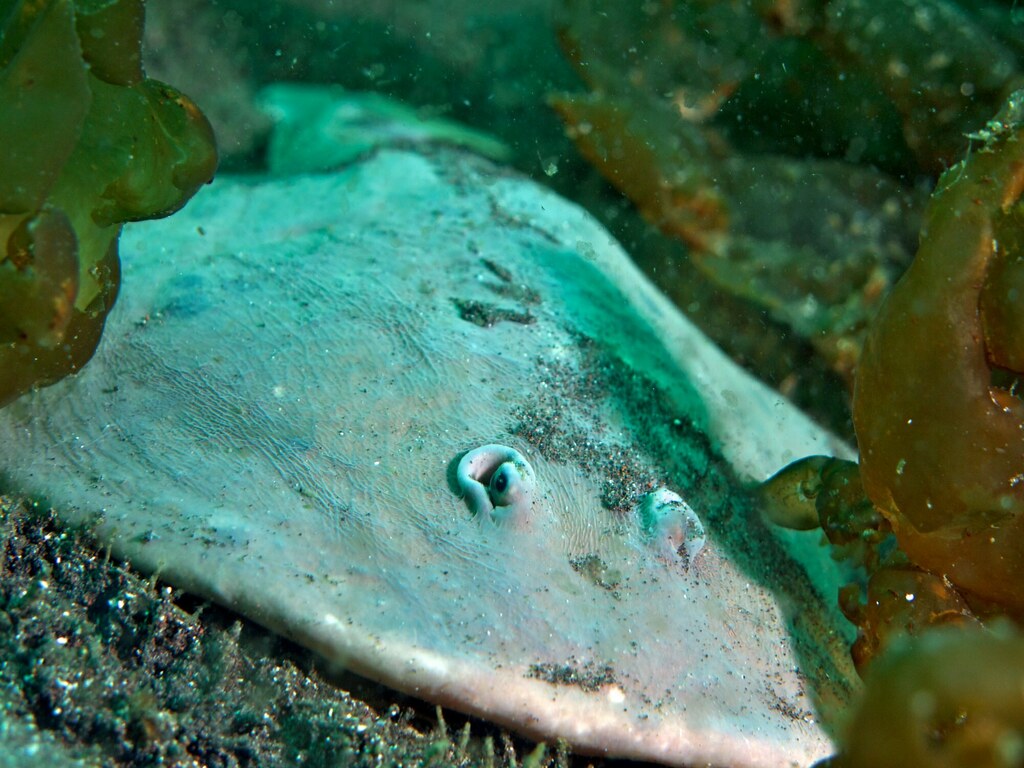
Photo credit: (c) RYO SATO, some rights reserved (CC BY-SA) · CC BY-SA · iNaturalist
About this species
The Japanese sleeper ray is a species of electric ray in the family Narkidae. It is common in the inshore and offshore waters of the northwestern Pacific Ocean from southern Japan to southern China. Growing up to 40 cm (16 in) long, the Japanese sleeper ray has a nearly circular pectoral fin disc colored reddish to chocolate brown above, sometimes with darker or lighter spots, and lighter brown below. The spiracles behind its small eyes have raised, smooth rims. Its short and muscular tail bears a single dorsal fin positioned aft of the rounded pelvic fins, and terminates in a large caudal fin.
Text from the Wikipedia article “Japanese sleeper ray”, licensed CC BY-SA 4.0. Read the article
Where and when
Where it has been recorded
Worldwide
Loading the map
Best months
Worldwide (open data)
- January: 0 records
- February: 1 records
- March: 2 records
- April: 3 records
- May: 2 records
- June: 1 records
- July: 0 records
- August: 1 records
- September: 1 records
- October: 3 records
- November: 5 records
- December: 2 records
Depth and water temperature
Depth
Mostly recorded at 7–570 m · Deepest record: 570 m
Water temperature
Recorded in surface water of 20–29 °C
Names and classification
- English
- Japanese electric ray, Japanese Sleeper Ray
Names in 4 more languages
- German
- Japanischer Schaufelzitterrochen, Japanischer Schläferrochen, Japanischer Zitterrochen
- Japanese
- シビレエイ
- Korean
- 전기가오리
- Simplified Chinese
- 日本單鰭電鰩, 日本單鰭電鱝, 日本電鱝, 雷魚, 電魴
Other scientific names: Crassinarke domitor, Crassinarke dormitor, Torpedo japonica
Similar species
- Numbray
Narke dipterygia
- Natal electric ray
Heteronarce garmani
Sources and credits
Names and taxonomy: WoRMS (CC BY 4.0) and the GBIF Backbone (CC BY 4.0). Photos: iNaturalist observers, each under the licence shown (CC0, CC BY or CC BY-SA).
- Depth, temperature, months and maps: records from OBIS and GBIF under CC0 or CC BY.
- Descriptions: Wikipedia, licensed CC BY-SA, each linked to its article.
- Conservation status as published by GBIF (IUCN Red List).
- 151 open-data records from 1900 to 2014.
- Species data updated November 4, 2026.
Log what you see on your next dive
The free DiveHive diver app keeps your logbook with every sighting and shows what lives at the site you dive next.