
DiscoverSpeciesSharks and rays
prickley dogfish
Oxynotus bruniensis
- Usual depth334–647 m
- Water temperature8–23 °C
- Best monthsMay, July, and October
- How commonOccasional
About this species
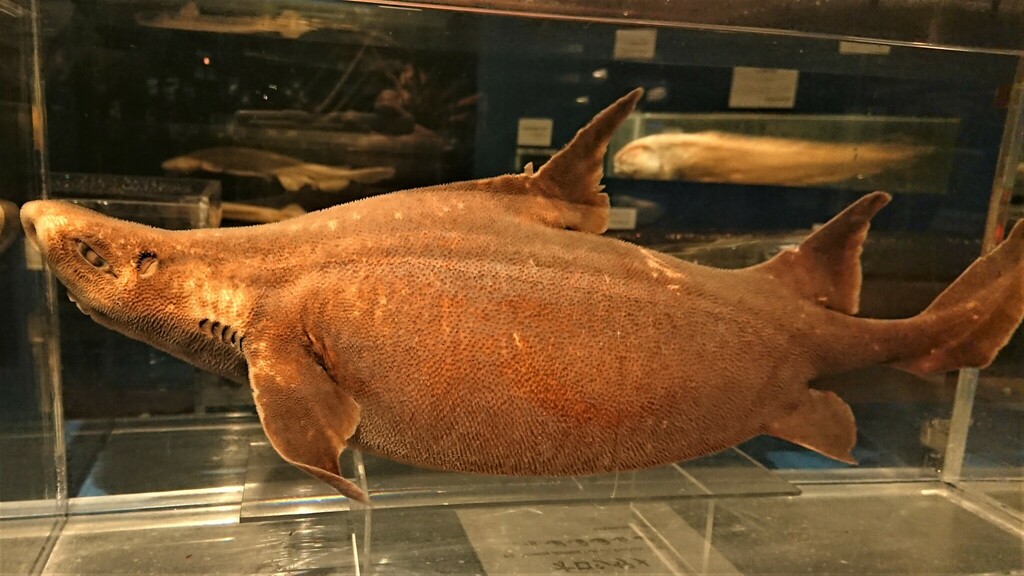
The prickly dogfish is a poorly known species of dogfish shark in the family Oxynotidae, inhabiting temperate Australian and New Zealand waters. Reaching a length of 75 cm (30 in), this brown to gray shark has a very thick body with a prominent "humpback" and extremely rough skin. It is further characterized by two enormous, sail-like dorsal fins placed relatively close together. Both dorsal fins have a spine embedded mostly within the fleshy leading portion of the fin; the first dorsal spine is tilted forward.
Text from the Wikipedia article “Prickly dogfish”, licensed CC BY-SA 4.0. Read the article
Where and when
Where it has been recorded
Worldwide
Loading the map
Best months
Worldwide (open data)
- January: 4 records
- February: 2 records
- March: 9 records
- April: 8 records
- May: 16 records
- June: 12 records
- July: 24 records
- August: 4 records
- September: 10 records
- October: 24 records
- November: 7 records
- December: 15 records
Depth and water temperature
Depth
Mostly recorded at 334–647 m · Deepest record: 1,081 m
Water temperature
Recorded in surface water of 8–23 °C
Names and classification
- English
- prickley dogfish, Prickly Dogfish, Rough Shark
Names in 3 more languages
- German
- Stachelige Meersau
- Spanish
- Cerdo marino espinoso
- Japanese
- ミナミオロシザメ
Other scientific names: Centrina bruniensis
Similar species
 Japanese Roughshark
Oxynotus japonicus
Sources and credits
Names and taxonomy: WoRMS (CC BY 4.0) and the GBIF Backbone (CC BY 4.0). Photos: iNaturalist observers, each under the licence shown (CC0, CC BY or CC BY-SA).
- Depth, temperature, months and maps: records from OBIS and GBIF under CC0 or CC BY.
- Descriptions: Wikipedia, licensed CC BY-SA, each linked to its article.
- Conservation status as published by GBIF (IUCN Red List).
- 936 open-data records from 1893 to 2018.
- Species data updated November 5, 2026.
Log what you see on your next dive
The free DiveHive diver app keeps your logbook with every sighting and shows what lives at the site you dive next.