
Short mackerel
Rastrelliger brachysoma
- Usual depth5–53 m
- Water temperature27–30 °C
- Best monthsAugust
- How commonRare
About this species
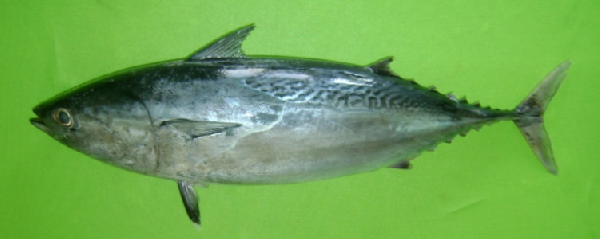
The short mackerel or short-bodied mackerel is a species of mackerel in the family Scombridae. Its habitat is the shallow waters of Southeast Asia and Melanesia, feeding mainly on small zooplankton. It is of major importance to the fisheries industry.
Text from the Wikipedia article “Short mackerel”, licensed CC BY-SA 4.0. Read the article
Where and when
Where it has been recorded
Worldwide
Loading the map
Best months
Worldwide (open data)
- January: 3 records
- February: 0 records
- March: 1 records
- April: 5 records
- May: 3 records
- June: 3 records
- July: 2 records
- August: 9 records
- September: 1 records
- October: 0 records
- November: 2 records
- December: 1 records
Depth and water temperature
Depth
Mostly recorded at 5–53 m · Deepest record: 53.1 m
Water temperature
Recorded in surface water of 27–30 °C
Names and classification
- English
- Short mackerel, shortbodied mackerel, Short-bodied Mackerel, short mackerel
Names in 3 more languages
- Spanish
- caballa rechoncha
- French
- maquereau trapu
- Japanese
- A Gurukuma
Other scientific names: Rastrelliger brachysomus, Rastrelliger neglectus, Rastrellinger brachysoma, Rastrilleger brachysoma, Scomber brachypomus, Scomber brachysoma, Scomber neglectus
Similar species
- Indian mackerel
Rastrelliger kanagurta
- island mackerel
Rastrelliger faughni
 Frigate mackerel
Auxis thazard
- Narrow-barred Spanish mackerel
Scomberomorus commerson
- Kawakawa
Euthynnus affinis
- Dogtooth tuna
Gymnosarda unicolor
Sources and credits
Names and taxonomy: WoRMS (CC BY 4.0) and the GBIF Backbone (CC BY 4.0). Photos: iNaturalist observers, each under the licence shown (CC0, CC BY or CC BY-SA).
- Depth, temperature, months and maps: records from OBIS and GBIF under CC0 or CC BY.
- Descriptions: Wikipedia, licensed CC BY-SA, each linked to its article.
- Conservation status as published by GBIF (IUCN Red List).
- 225 open-data records from 1851 to 2018.
Log what you see on your next dive
The free DiveHive diver app keeps your logbook with every sighting and shows what lives at the site you dive next.