
Whiteface moray
Echidna leucotaenia
- Usual depth0–7 m
- Water temperature23–30 °C
- Best monthsJuly and August
- How commonRare
About this species
Echidna leucotaenia, the whiteface moray, also known as the white-banded moray eel, is a moray eel. It was described by Schultz in 1943. It is a tropical, marine and freshwater eel which is known from the Indo-Pacific, including East Africa, the Line Islands, the Tuamotu Islands, and Johnston Island. It dwells at a depth range of 0 to 24 metres, and leads a benthic lifestyle in reefs. Males can reach a maximum total length of 75 centimetres (30 in).
Text from the Wikipedia article “Echidna leucotaenia”, licensed CC BY-SA 4.0. Read the article
Where and when
Where it has been recorded
Worldwide
Loading the map
Best months
Worldwide (open data)
- January: 1 records
- February: 0 records
- March: 0 records
- April: 3 records
- May: 3 records
- June: 3 records
- July: 9 records
- August: 7 records
- September: 5 records
- October: 4 records
- November: 5 records
- December: 0 records
Depth and water temperature
Depth
Mostly recorded at 0–7 m · Deepest record: 21.8 m
Water temperature
Recorded in surface water of 23–30 °C
Names and classification
- English
- Whiteface moray, White-banded Moray Eel, whiteface moray, Whiteface Moray
Names in 1 more languages
- French
- Murène à face blanche
Similar species
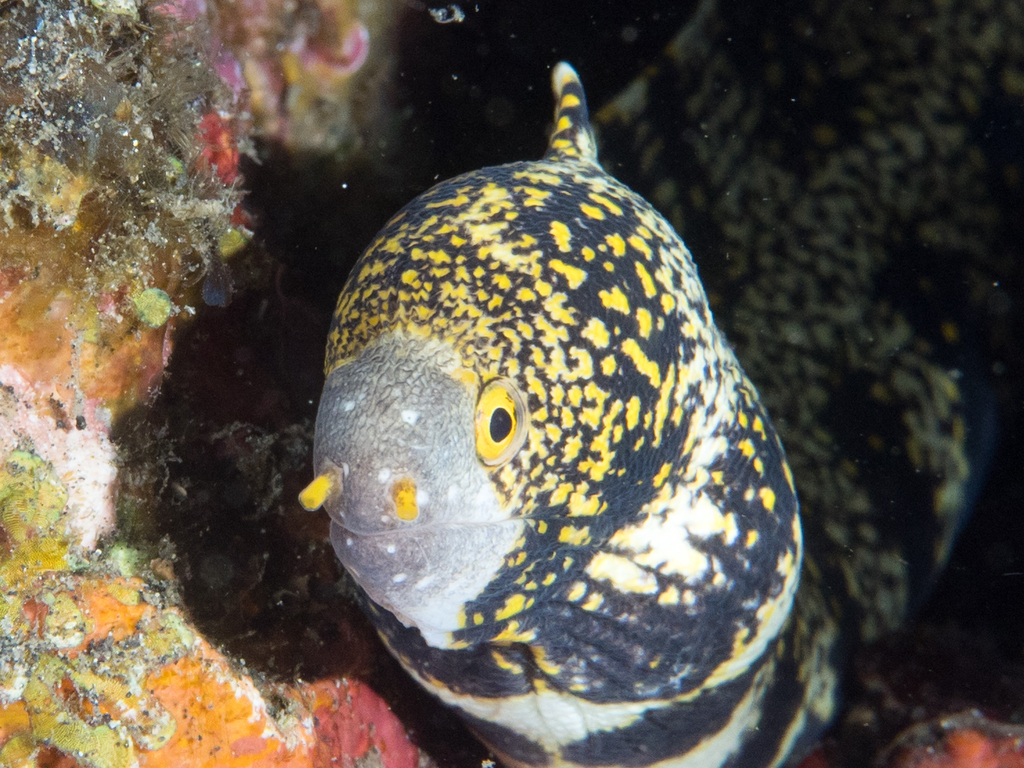 Snowflake moray
Echidna nebulosa
 Barred moray
Echidna polyzona
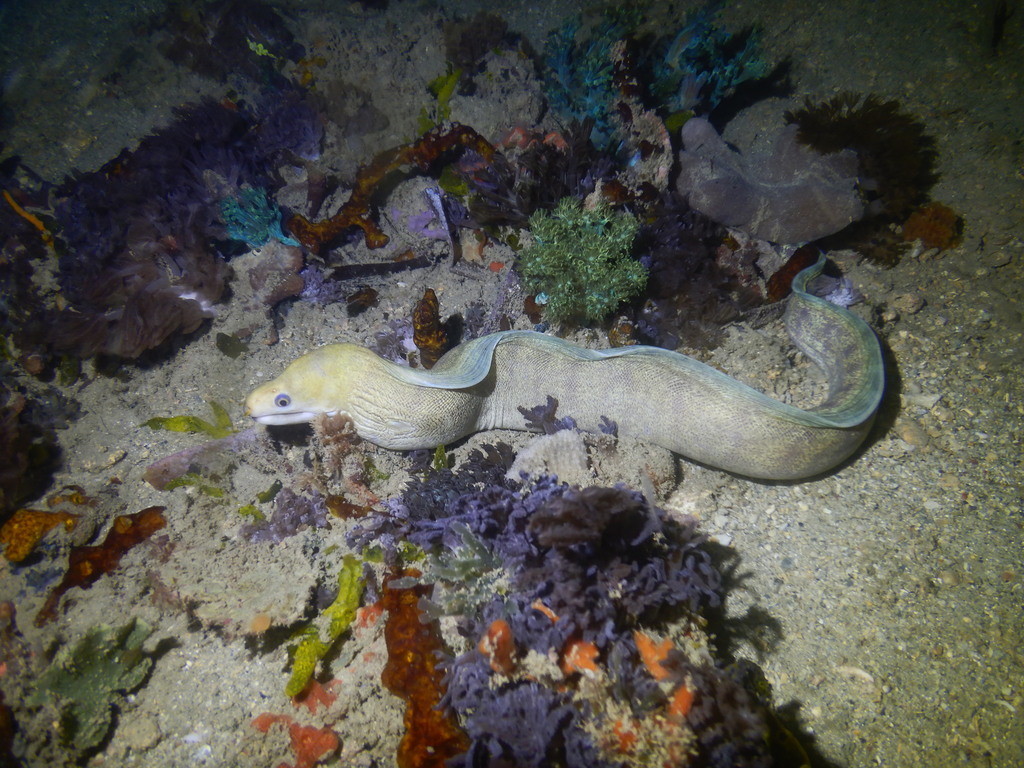 Fine-speckled Moray
Echidna delicatula
- Sulawesi moray
Echidna amblyodon
- Freshwater Moray
Echidna rhodochilus
- Pale Moray
Echidna unicolor
Sources and credits
Names and taxonomy: WoRMS (CC BY 4.0) and the GBIF Backbone (CC BY 4.0). Photos: iNaturalist observers, each under the licence shown (CC0, CC BY or CC BY-SA).
- Depth, temperature, months and maps: records from OBIS and GBIF under CC0 or CC BY.
- Descriptions: Wikipedia, licensed CC BY-SA, each linked to its article.
- Conservation status as published by GBIF (IUCN Red List).
- 111 open-data records from 1939 to 2005.
- Species data updated November 2, 2026.
Log what you see on your next dive
The free DiveHive diver app keeps your logbook with every sighting and shows what lives at the site you dive next.