
DiscoverSpeciesSharks and rays
Myliobatis australis
- Usual depth53–430 m
- Water temperature11–28 °C
- Best monthsNovember
- How commonRare
About this species
The New Zealand eagle ray or Australian eagle ray is an eagle ray of the family Myliobatidae, found in bays, estuaries, and near rocky reefs around New Zealand and southern Australia on the inner continental shelf. It is a common species and the International Union for Conservation of Nature has assessed its conservation status as being of "least concern".
Text from the Wikipedia article “New Zealand eagle ray”, licensed CC BY-SA 4.0. Read the article
Where and when
Where it has been recorded
Worldwide
Loading the map
Best months
Worldwide (open data)
- January: 0 records
- February: 0 records
- March: 0 records
- April: 0 records
- May: 0 records
- June: 0 records
- July: 0 records
- August: 0 records
- September: 0 records
- October: 0 records
- November: 7 records
- December: 1 records
Depth and water temperature
Depth
Mostly recorded at 53–430 m · Deepest record: 505 m
Water temperature
Recorded in surface water of 11–28 °C
Names and classification
Similar species
- Australian Eagle Ray
Myliobatis tenuicaudatus
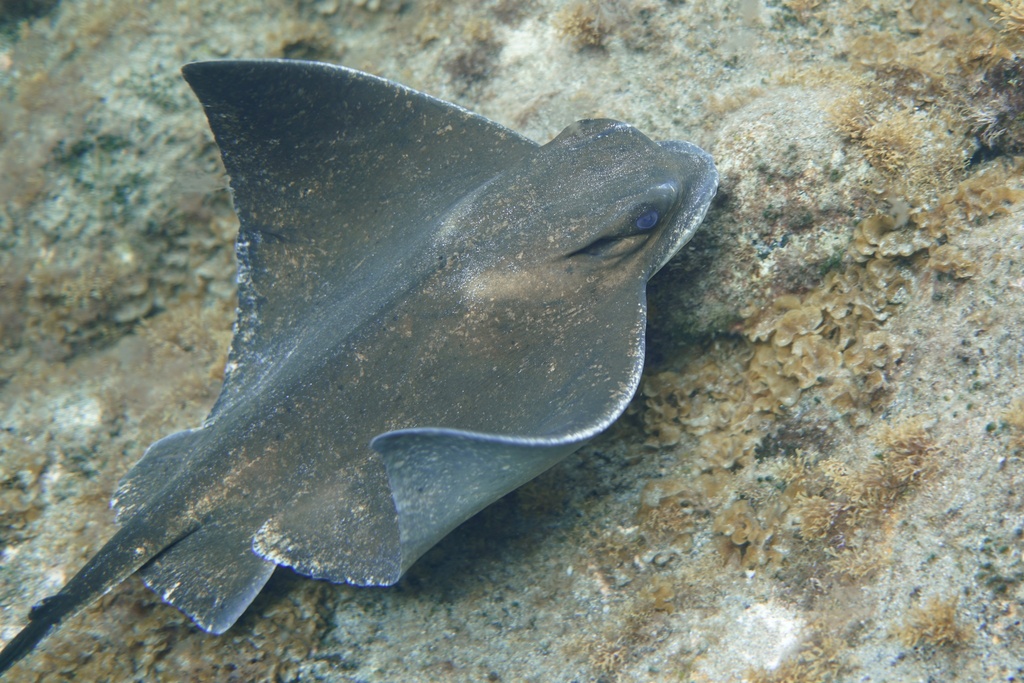 Common eagle ray
Myliobatis aquila
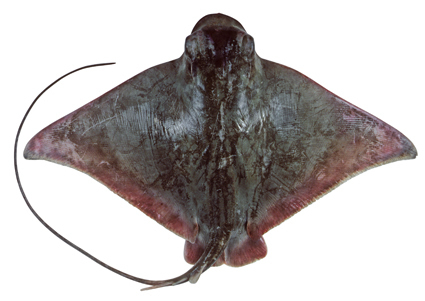 Hamlyn's Bull-ray
Myliobatis hamlyni
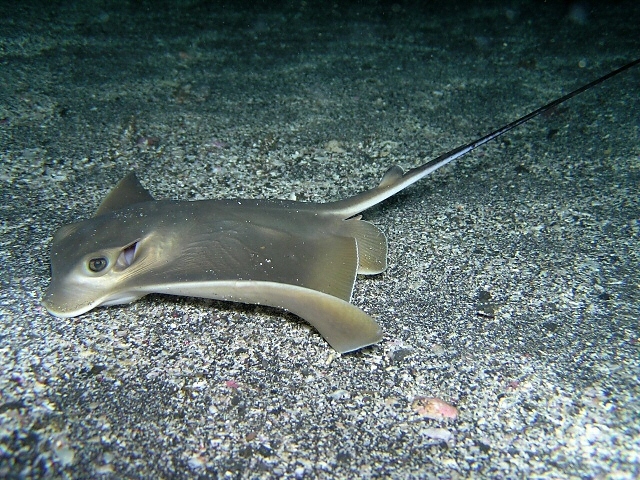 Japanese Eagle Ray
Myliobatis tobijei
 Bull ray
Aetomylaeus bovinus
 Ornate eagle ray
Aetomylaeus vespertilio
Sources and credits
Names and taxonomy: WoRMS (CC BY 4.0) and the GBIF Backbone (CC BY 4.0). Photos: iNaturalist observers, each under the licence shown (CC0, CC BY or CC BY-SA).
- Depth, temperature, months and maps: records from OBIS and GBIF under CC0 or CC BY.
- Descriptions: Wikipedia, licensed CC BY-SA, each linked to its article.
- Conservation status as published by GBIF (IUCN Red List).
- 74 open-data records from 1968 to 2023.
- Species data updated November 4, 2026.
Log what you see on your next dive
The free DiveHive diver app keeps your logbook with every sighting and shows what lives at the site you dive next.