
DiscoverSpeciesSharks and rays
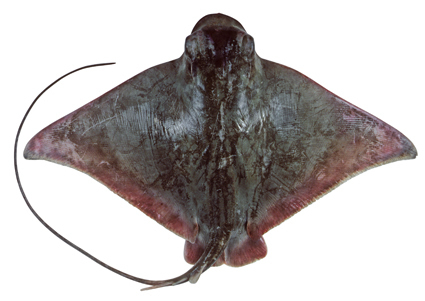
Hamlyn's Bull-ray
Myliobatis hamlyni
- Usual depth127–357 m
- Water temperature21–28 °C
- Best monthsJanuary, March, and April
- How commonRare
Photo credit: (c) CSIRO National Fish Collection, some rights reserved (CC BY) · CC BY · iNaturalist
About this species
The purple eagle ray is a species of fish in the family Myliobatidae. It was formerly considered endemic to Australia but is now known to be more widespread. Its natural habitat is the open seas where it has a patchy distribution, and the International Union for Conservation of Nature has assessed its conservation status as being "near-threatened".
Text from the Wikipedia article “Purple eagle ray”, licensed CC BY-SA 4.0. Read the article
Where and when
Where it has been recorded
Worldwide
Loading the map
Best months
Worldwide (open data)
- January: 3 records
- February: 0 records
- March: 3 records
- April: 3 records
- May: 1 records
- June: 1 records
- July: 3 records
- August: 3 records
- September: 0 records
- October: 2 records
- November: 3 records
- December: 0 records
Depth and water temperature
Depth
Mostly recorded at 127–357 m · Deepest record: 357 m
Water temperature
Recorded in surface water of 21–28 °C
Names and classification
- English
- Hamlyn's Bull-ray, Purple Bull-ray, Purple Eagle Ray, Purple Ray
Names in 1 more languages
- Japanese
- Sumiretobiei, スミレトビエイ
Similar species
- Australian Eagle Ray
Myliobatis tenuicaudatus
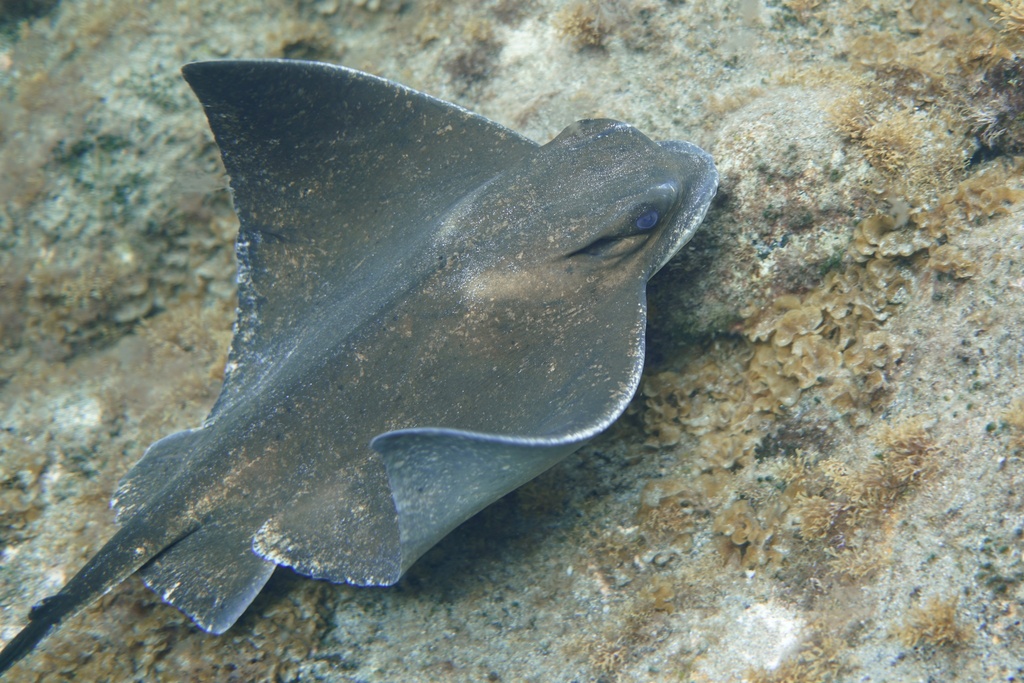 Common eagle ray
Myliobatis aquila
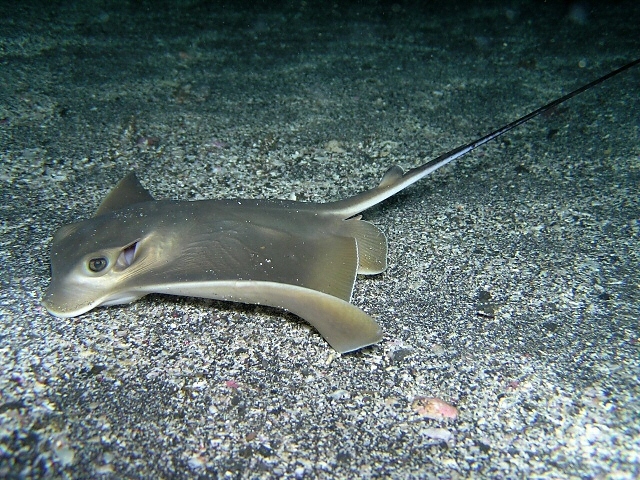 Japanese Eagle Ray
Myliobatis tobijei
 Bull ray
Aetomylaeus bovinus
 Ornate eagle ray
Aetomylaeus vespertilio
Sources and credits
Names and taxonomy: WoRMS (CC BY 4.0) and the GBIF Backbone (CC BY 4.0). Photos: iNaturalist observers, each under the licence shown (CC0, CC BY or CC BY-SA).
- Depth, temperature, months and maps: records from OBIS and GBIF under CC0 or CC BY.
- Descriptions: Wikipedia, licensed CC BY-SA, each linked to its article.
- Conservation status as published by GBIF (IUCN Red List).
- 29 open-data records from 1976 to 1999.
- Species data updated November 4, 2026.
Log what you see on your next dive
The free DiveHive diver app keeps your logbook with every sighting and shows what lives at the site you dive next.