
Longjaw thryssa
Thryssa setirostris
- Usual depth5–82 m
- Water temperature23–30 °C
- Best monthsApril, June, and November
- How commonOccasional
About this species
Thryssa setirostris, the longjaw thryssa, is a species of ray-finned fish in the family Engraulidae. It is found in the Indo-Pacific.
Text from the Wikipedia article “Thryssa setirostris”, licensed CC BY-SA 4.0. Read the article
Where and when
Where it has been recorded
Worldwide
Loading the map
Best months
Worldwide (open data)
- January: 8 records
- February: 12 records
- March: 8 records
- April: 22 records
- May: 16 records
- June: 21 records
- July: 13 records
- August: 7 records
- September: 12 records
- October: 14 records
- November: 23 records
- December: 7 records
Depth and water temperature
Depth
Mostly recorded at 5–82 m · Deepest record: 92.5 m
Water temperature
Recorded in surface water of 23–30 °C
Names and classification
- English
- Longjaw thryssa, Long-horned Anchovy, longjaw thryssa, New Guinea thryssa
Names in 4 more languages
- Spanish
- bocarte de cuernos
- French
- anchois-moustache cornu
- Thai
- ปลาแมวงายาว
- Simplified Chinese
- 含西, 突鼻仔, 臭肉仔, 長吻劍鰶, 長頜棱鯷
Other scientific names: Clupea mystacina, Clupea seticornis, Clupea setirostris, Engraulis setirostris, Scutengraulis setirostris, Thrissa setirostris, Thrissocles setirostris, Thryssa macrognathos
Similar species
- New Jersey anchovy
Thryssa encrasicholoides
- Hamilton's Anchovy
Thryssa malabarica
 Shorthead anchovy
Encrasicholina heteroloba
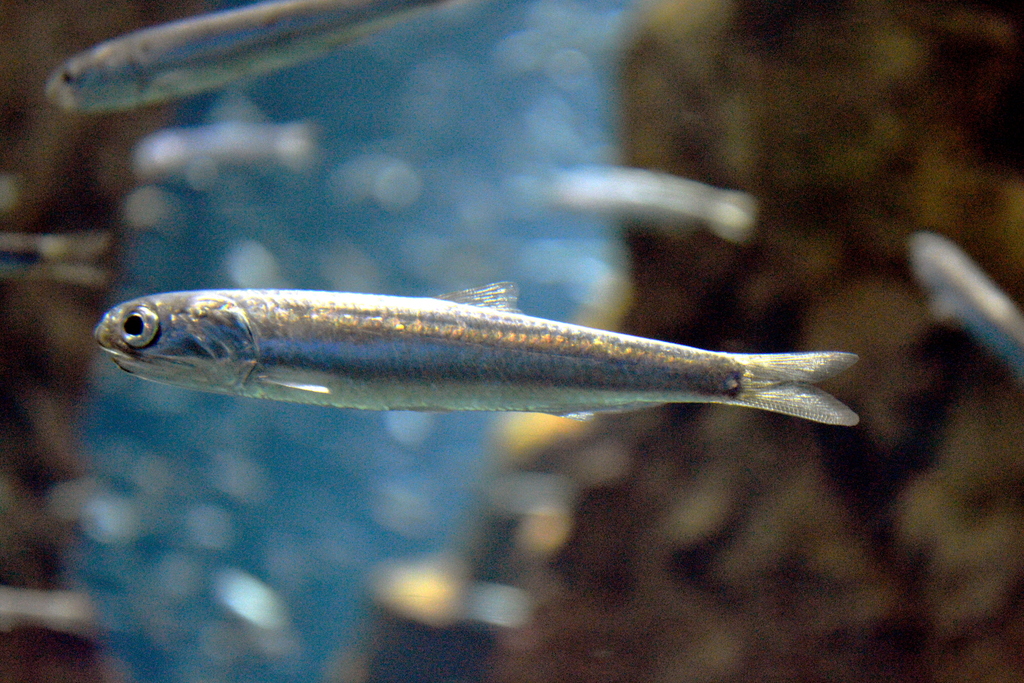 Japanese anchovy
Engraulis japonicus
- Buccaneer anchovy
Encrasicholina punctifer
- Commerson's anchovy
Stolephorus commersonnii
Sources and credits
Names and taxonomy: WoRMS (CC BY 4.0) and the GBIF Backbone (CC BY 4.0). Photos: iNaturalist observers, each under the licence shown (CC0, CC BY or CC BY-SA).
- Depth, temperature, months and maps: records from OBIS and GBIF under CC0 or CC BY.
- Descriptions: Wikipedia, licensed CC BY-SA, each linked to its article.
- Conservation status as published by GBIF (IUCN Red List).
- 1,819 open-data records from 1782 to 2023.
Log what you see on your next dive
The free DiveHive diver app keeps your logbook with every sighting and shows what lives at the site you dive next.